

The Web3 Stack and the Blockchain Interaction Layer
Taking a holistic view, dev tools in Web3 exist in areas such as:
- Nodes, e.g. Alchemy, help devs connect to the blockchain networks
- On-chain data querying and indexing, e.g. The Graph, help back-end devs to query and index data on-chain (This area is important as many Web3 projects have the need. e.g. holders community operation for NFT projects, transactions tracking for DeFi protocols, etc.)
- Oracle, e.g. Chainlink, help smart contract devs to call data off-chain
- Decentralized storage, e.g. IPFS
- …
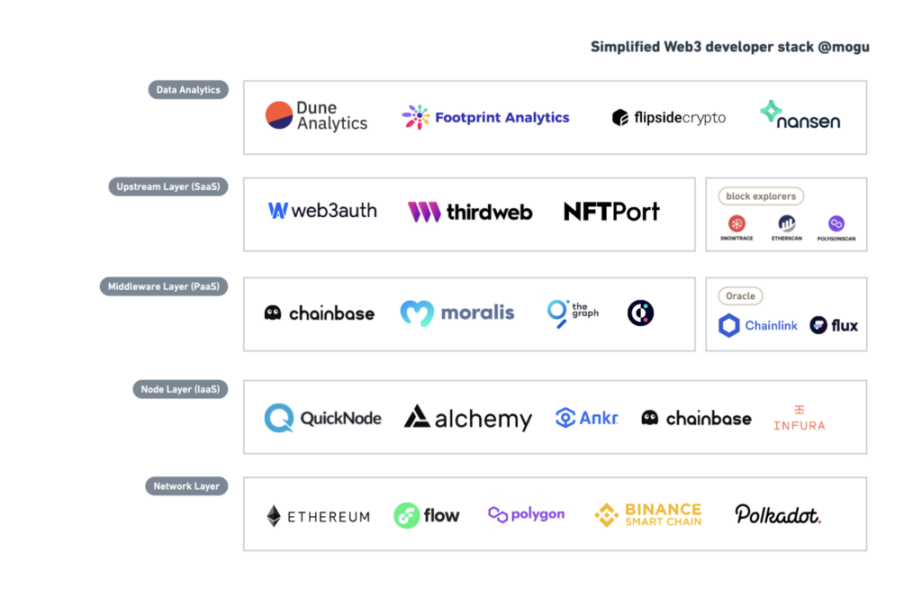
Based on the experience of interacting with blockchain as a developer, Mogu, founder of Chainbase, sorts these areas out and puts forward a five-layer framework to help understand the Web3 dev tooling. Basically, the Web3 developer stack can be divided into: network layer, node layer (IaaS), middleware layer (PaaS), upstream layer (SaaS), and data analytics layer.
As an infrastructure functioning on the blockchain interaction layer, Chainbase aims to ease the process of onboarding Web3 for devs by providing a complete set of tools that enable them to interact with the blockchain in a familiar way (using familiar languages, etc.)
Generally, devs need to complete the following steps for blockchain interaction:
- Build nodes to connect to the blockchain
- Decode (data cleaning) and structurize the data on multiple chains
- Query and index data using APIs
- …
Here we use the three services (Chain API, Web3 API, deCrypto Data Cloud) that Chainbase is providing as examples to list the challenges in the process as well as how different dev tools help solve them.
The Challenges and Dev Tools in the process of Blockchain Interaction
a. Chain API Service (JSON RPC)
Key issue: connect to the blockchain networks. However, it is costly and time-consuming to build nodes by the project itself, especially when it is early-stage.
For example, to connect to Ethereum, devs need to do the following:
- Purchase cloud services (either centralized clouds such as AWS, Google Cloud, Azure, etc. or decentralized cloud computing services), install Geth nodes (concern: money)
- Sync data (concern: operation and maintenance cost, time cost)
- Use JSON RPC API (self-built or using third-party providers) to connect to Ethereum
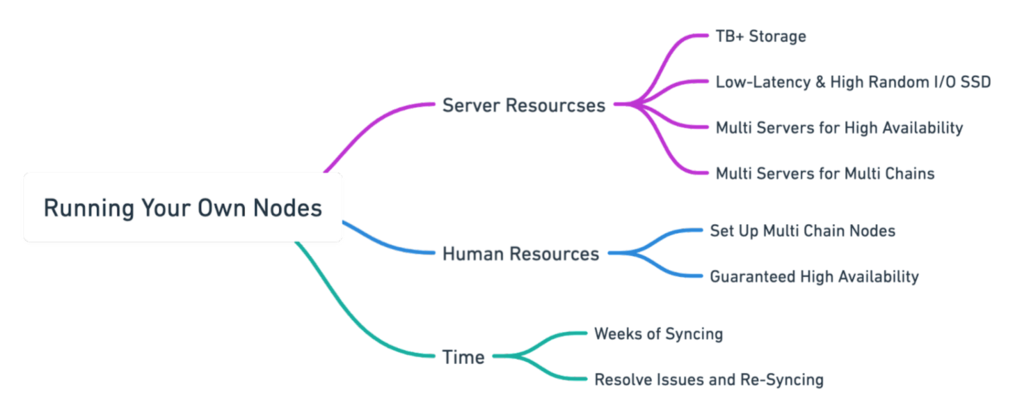
To complete the process by the project itself, the costs include:
- Cloud services (depending on how much computing is used) + operation and maintenance + additional cost
- Load balancing cost (for centralized cloud services) to avoid the service breakdown risk
Collectively, it may cost 10,000 USD or more per month (even for small projects) plus extra time put into maintenance that could be spent on product development. On the contrary, using third-party providers saves time and costs — which can be under 100 USD monthly. Therefore, most projects adopt the latter solution.
Similar providers: Alchemy, Infura, QuickNode, Ankr, InfStones, etc.
The major focus of these companies is the node service, while Chainbase focuses on data querying/indexing, with node service as part of our package. Moreover, their pricing is not friendly for small teams as well as individual devs.
b. Web3 API Service
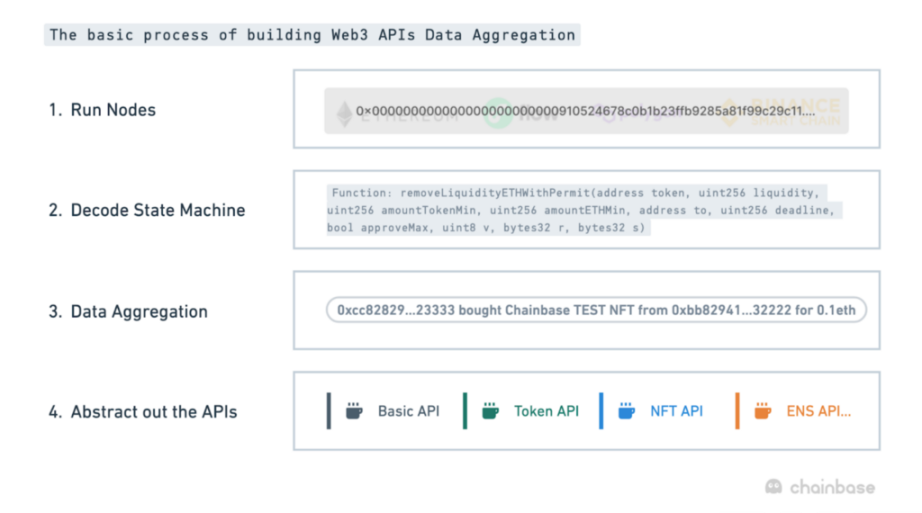
Key issue: after connecting to the networks, query and index the data. However, the on-chain data is not “ready to be analyzed”. Moreover, devs need to deal with the different data structures of EVM (ETH, layer 2s, etc.) and non-EVM chains (Solana, Flow, etc.).
Blockchain networks are essentially distributed ledgers and can be viewed as “databases” consisting of “unorganized” data. For example, to query protocol-level data (ERC20, ERC721, ERC1155, ERC137, etc.) on EVM chains for common business scenarios (token, NFT, ENS domain name, etc.), devs should decode and structurize the on-chain data first, and then proceed to data querying and indexing via APIs. Also, they have to do the same thing for multiple chains (note that decoding the data on non-EVM chains is more complicated) and for different protocols.
Similar providers: Moralis, The Graph
Moralis provides template APIs and is not open. If the APIs they’re providing do not meet the client’s needs, it might be troublesome. Chainbase enables custom configuration thus more flexible.
The Graph only provides data indexing for a few chains and is limited to dApp scenarios. However, the data generated by dApps only accounts for a small portion of blockchain networks. Moreover, its GRT is not cloudized, so it cannot provide a data cloud service to satisfy the long-tail needs of devs.
c. deCrypto Data Cloud
Key issue: for some emerging projects (established ones as well) that have innovative needs associated with uncommon business scenarios, it will be hard to find and use existing APIs. Therefore, a platform that enables them to automatically customize APIs is needed.
Web3 Data is Hard. Real-time is harder.
The fundamental challenges to building a platform like this include:
- Real-time capability
- Storage cost
- Response speed
- Technical difficulty
- Operations and maintenance cost
Therefore, it would be technically-difficult, time-consuming, and costly for individual devs or dev teams at Web3 projects to build their own database.
Building on Web3 API, after processing multi-tenant isolation and security monitoring, Chainbase provides the service openly and transparently to developers, so that they can program freely using SQL and generate customized APIs on our platform. You can think of it as an abstract layer on top of blockchain networks that aggregates all data from multiple chains together in one place, so that developers can do real-time on-chain data querying/indexing/etc. using this database.
What devs can do with deCrypto Data Cloud:
- Terminal functionality — SQL
- Querying — data
- Creating APIs — owner
- Back-end coding — APIs and beyond
Similar provider: we don’t see a direct competitor on market now, but you can think of deCrypto Data Cloud as the open real-time dev-facing version of Dune Analytics.
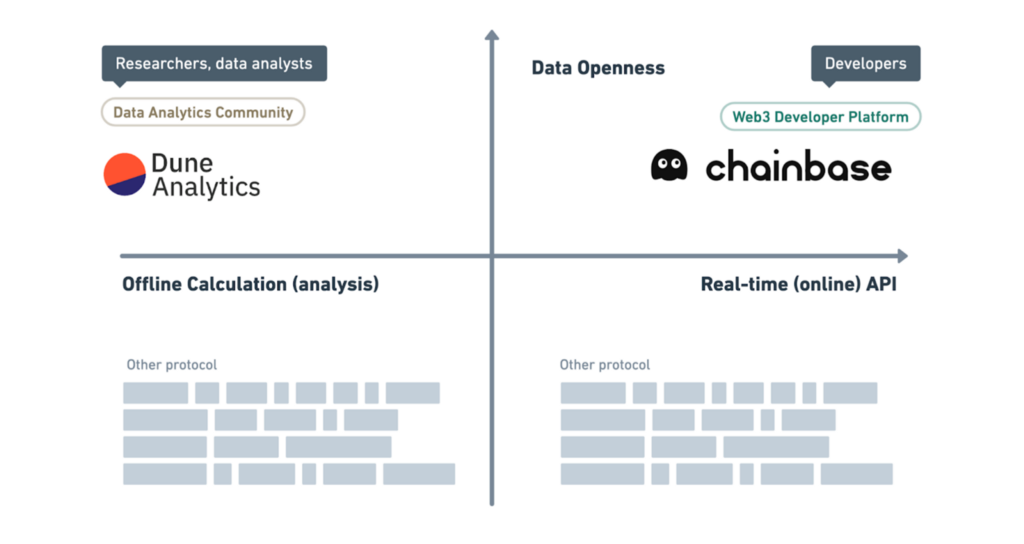
What’s the difference between deCrypto Data Cloud & Dune Analytics:
- Chainbase employs real-time computing (data is refreshed in secs) and offers a real-time database for devs, while Dune Analytics provides offline analysis dashboards (data is updated on a daily basis).
- deCrypto Data Cloud is mainly for back-end devs rather than data analysts. Back-end devs use the product to create APIs, query data, and return the results to front-end devs. (Background info: back-end devs focus on logic + database, while front-end devs work on user-end interaction). Dune Analytics functions as a data-graph BI (Business Intelligence) application for researchers, analysts, investors, etc. The value chain here: back-end devs generate APIs for data analysts to create dashboards for end-users to view and make decisions accordingly.
d. Dev Suite
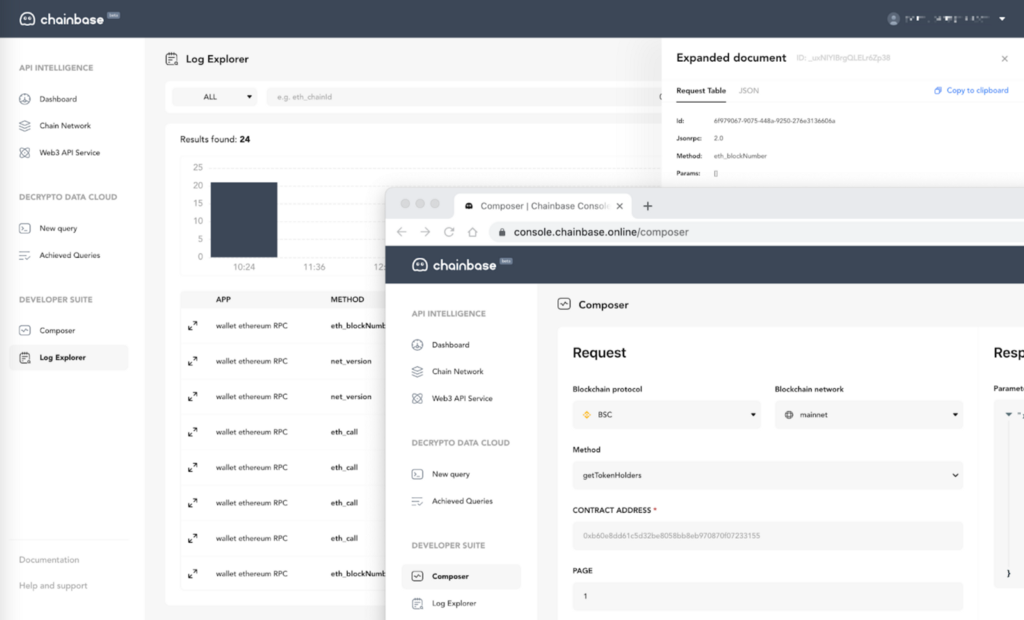
When devs employ dApps using our product, they want to monitor the status of the APIs, including but not limited to: debugging, SDKs, etc. As a dev-centric team ourselves, we provide an all-in-one dev-friendly interface for users to manage related activities conveniently — which can be considered a complementary service to the above three.
About Chainbase
Chainbase is a leading Web3 blockchain interaction layer infrastructure. By providing cloud-based API services, it helps developers quickly access and utilize blockchain networks and easily build Web3 applications.
Chainbase makes blockchain interaction and data query/index on chains simple and easy. Anyone can use, build and publish open APIs, which allows developers to focus on application-level innovation instead of solving the back-end hassles.
Chainbase currently supports Ethereum, Polygon, BSC, Fantom, Avalanche, Arbitrum, and other chains. This allows projects of all sizes to reduce development time and costs, no matter which chains they are building on!
As analyzed in this article, Chainbase’s competitive advantages lie in:
- Real-time multi-chain data querying/indexing
- Custom APIs generated via SQL
- All-in-one dev-friendly interface
- Stable service and affordable pricing
- Timely technical support
Stay connected with Chainbase on Medium, Twitter, and Discord. If you are a back-end dev and would like to experience the product, please submit a request as well as read the dev documentation on our website.
【免责声明】市场有风险,投资需谨慎。本文不构成投资建议,用户应考虑本文中的任何意见、观点或结论是否符合其特定状况。据此投资,责任自负。