



As 2026 unfolds, the global cryptocurrency market is undergoing a quiet but profound structural shift. Data from blockchain intelligence firm TRM Labs shows global retail crypto activity contracted by 11% year-over-year in Q1, settling at $979 billion. Superficially, this points to a cooling market. Beneath the headline, however, capital flows and user behaviour are fundamentally reconfiguring: attention is moving away from pure speculation toward stablecoin settlement, onchain payments, and decentralised identity infrastructure.
For many, cryptocurrency remains synonymous with speculation, portfolio accumulation, and DeFi yield farming. In reality, though, its everyday footprint has already expanded significantly. From restaurants in New York to cafes in Singapore, and from settling a Haidilao bill to gaining entry at music festivals, cryptocurrency payments are increasingly woven into daily commerce, operating with the seamlessness of traditional card networks. Just a few years ago, purchasing a coffee with cryptocurrency required navigating OTC desks, absorbing ~2% FX slippage, and bracing for potential bank freezes. Today, the process is frictionless: open a crypto card app, fund it with USDC, and tap or scan to pay.
This is the shift consumer crypto is driving: transforming blockchain from a niche, technical tool into an everyday service that regular people can actually use. This evolution is unfolding along two complementary tracks. The first prioritizes privacy, leveraging cryptography to shield user data in digital commerce. The second emphasizes seamless utility, embedding NFT ticketing, tokenized loyalty programs, and on-chain social graphs directly into high-frequency consumer routines.
Against this backdrop, a multi-layered ecosystem is gradually taking shape:
- Payment Layer (Crypto Cards): Built on stablecoins, connecting onchain assets to real-world spending.
- Consumption Layer (Applications): Projects, like Blackbird and RaveDAO, turning dining and entertainment into onchain experience.
- Identity Layer (Decentralised Social Apps): Rebuilding digital identity and social graphs to create portable, reusable trust for consumer behaviour.
Collectively, these layers map a clear trajectory: crypto assets are moving from speculative screen balances to spendable capital, and ultimately into portable, onchain credit anchored to identity. Yet this convenience carries an inherent friction: Know Your Customer (KYC) compliance. KYC remains the indispensable cornerstone of regulatory adherence, but it is also the single greatest bottleneck to user experience today.
This tension frames the central question of this report: within consumer crypto’s three-layer architecture (payments, applications, and identity), can KYC evolve from a repetitive, document-heavy hurdle into a reusable, low-friction identity layer that users genuinely control? How this question is answered will ultimately determine whether cryptocurrency remains a specialised financial niche or becomes infrastructure embedded in the daily lives of billions.
1. Crypto Cards: The Bridge Between Onchain Assets and the Real World
1.1 What are Crypto Cards and Why Do We Need Them?
At its core, a crypto card is a prepaid, debit, or credit card funded with cryptocurrency. Users deposit stablecoins such as USDC or USDT; at the point of sale, the system instantly converts the cryptocurrency into local fiat at real-time exchange rates to settle the transaction. To the end user, the experience is virtually indistinguishable from using a conventional Visa or Mastercard. Merchants receive fiat currency as usual, entirely unaware that crypto assets powered the payment. This seamless abstraction is precisely why crypto cards have become the most direct conduit between onchain wealth and offline commerce.
The rapid adoption of crypto cards stems from how effectively they address region-specific user pain points:
- Bypassing OTC Friction: Crypto cards eliminate the exchange-rate slippage typical of OTC withdrawals (often ~2%) and the persistent risk of bank account freezes. Instead, users benefit from safe, real-time conversions with direct settlement at the point of sale.
- Reshaping Financial Access in Emerging Markets: In regions grappling with currency instability, capital controls, or underdeveloped banking infrastructure, such as Latin America, Southeast Asia, the Middle East, and Africa, crypto cards provide a critical on-ramp to “digital dollars” and instant access to the global merchant network. Providers like Redotpay, KAST, and Holyheld are prime examples of this approach.
1.2 Market Size: Growth That Defies Expectations
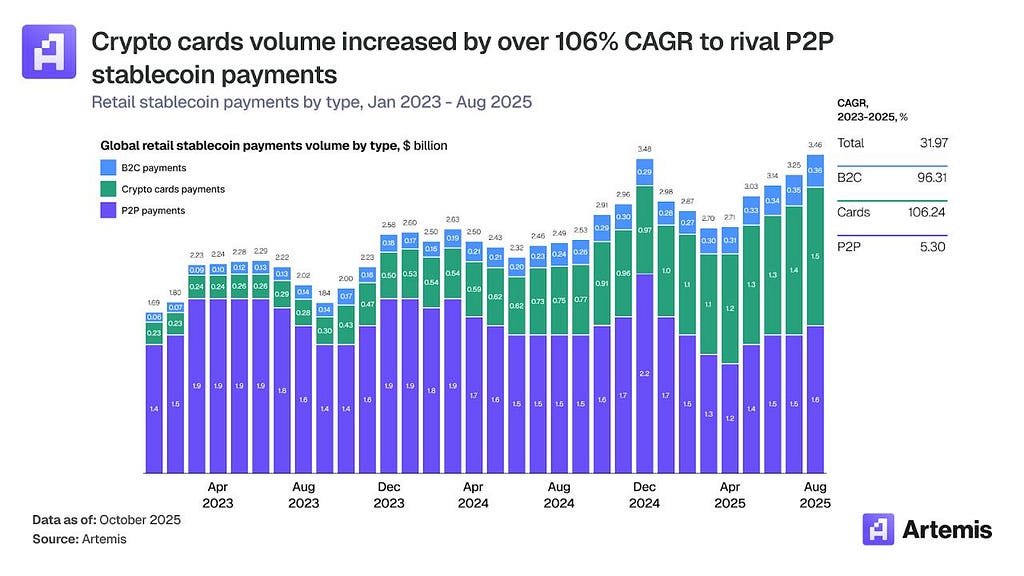
The crypto card market is expanding rapidly, with transaction volumes now rivaling traditional P2P stablecoin transfer activity. According to Artemis Research, monthly crypto card transaction volume grew from roughly $100 million in early 2023 to over $1.5 billion by the end of 2025, representing a 106% compound annual growth rate. By March 2026, monthly volume had grown another 211% year-over-year.
Behind this growth, two payment giants, Visa and Mastercard,have played a central role:
- Visa (over 90% market share): Visa has taken an “infrastructure-first” approach, partnering deeply with providers such as Rain and Reap. Through a single integration, it can plug into dozens of downstream card issuers, allowing it to scale distribution and capture market growth quickly.
- Mastercard: Mastercard has focused on directly integrating with large centralised platforms and exchanges, such as Revolut and Bybit. In March 2026, it made a strategic move by acquiring stablecoin infrastructure company BVNK for $1.8 billion, a clear signal of its long-term commitment to the space.
1.3 Overview of Mainstream Crypto Cards
The current crypto card market can be broadly segmented into four primary categories based on their underlying architectures and business models, with each exhibiting notable distinctions in functional focus and Know Your Customer (KYC) requirements.
Alongside this segmentation, a new trend is rapidly gaining momentum across the Asia-Pacific and Latin American markets: stablecoin QR code payments are carving out a lighter, more streamlined pathway to bring crypto payments into offline retail environments.
Category 1: CEX Co-Branded Cards — An Extension of Exchange Traffic
Deeply integrated with exchange wallets, these cards primarily operate as prepaid or debit instruments, with select offerings featuring cryptocurrency cashback. Their core purpose is to convert dormant platform balances into active consumer spending. Key examples include the Bybit Card, Binance Card, Coinbase Card, and the recently upgraded Gate Card.
From a KYC perspective, these cards seamlessly inherit their parent exchange’s verification framework. While existing users with advanced verification experience a frictionless onboarding process, newcomers face a steep initial barrier: government-issued ID, facial recognition, and proof of address are mandatory.
Take the Bybit Card, for instance. While it accommodates mainland Chinese KYC, users must first complete the exchange’s Tier 2 verification (ID plus facial recognition). The card carries no annual fee, supports both Apple Pay and Google Pay, and operates at a blended fee rate of 0.9%–3%. Promotional campaigns have offered up to 10% cashback, and in early 2026, the European Union variant introduced a dedicated BTC cashback feature.

The Binance and Coinbase cards, meanwhile, reflect entirely different strategic trade-offs. The Binance Card has been heavily shaped by shifting regulatory landscapes, leading to suspended issuance in certain jurisdictions. Its KYC process remains tightly coupled with the underlying exchange account, presenting a notably high compliance threshold. Conversely, the Coinbase Card is heavily optimised for the U.S. domestic market, mandating bank-grade identity verification. For non-U.S. residents, this adds an extra layer of friction to both application and daily use.
By contrast, the Gate Card, launched in March 2026, appears meticulously engineered for contemporary spending habits. It offers up to 5% cashback in BTC, ETH, USDT, or GT, carries a flat 1% transaction fee, and allows premium users to offset trading fees with their rewards, effectively generating net-positive yields. Monthly cashback is capped at 250 USDT. Given that contactless transactions have become the default standard in 2026, the Gate Card was designed from day one to support NFC terminals, Apple Pay, and Google Pay, entirely bypassing the need for physical card swipes.

Category 2: Self-Custody & Protocol-Native Cards — Payment Instruments Embedded with DeFi Principles
These cards prioritise absolute user control over assets while seamlessly integrating DeFi mechanics, such as yield generation and collateralized lending. Notable examples include Ether.fi Cash Card, MetaMask Card, Phantom Card, Ready Card, and UR Card.
The Ether.fi Cash Card, in particular, has carved out a distinct niche with its innovative “spend-your-yield” borrow mode. This feature enables users to pledge staked or restaked assets, such as eETH, as collateral for daily spending, all while continuing to earn yield on the underlying position. Generated rewards can then be applied directly toward transaction settlements, seamlessly synchronising long-term asset accumulation with everyday consumption. This closed-loop architecture significantly enhances capital efficiency and has driven rapid adoption: the card now accounts for nearly half of all crypto-native card volume, with approximately 70,000 active cards and 300,000 associated accounts. Furthermore, in early 2026, the Ether.fi DAO approved a $50 million ETHFI buyback program, followed by a February migration from Scroll to OP Mainnet to enhance throughput and liquidity.

Conversely, the MetaMask Card illustrates how wallet giants are positioning themselves as primary payment gateways. Developed in partnership with Mastercard and rolled out nationwide in the U.S. in February 2026, the card is natively embedded within the MetaMask ecosystem and settles transactions via the Linea network. Structurally, the virtual tier offers 1% cashback, while the premium metal card delivers 3% (subject to a $199 annual fee), with daily spending limits reaching $15,000. Cardholders also gain access to Web3-exclusive perks spanning travel and dining. Backed by institutional-grade infrastructure, the card delivers exceptional payment success rates and robust compliance, positioning it as one of the most TradFi-aligned onchain payment solutions available today.

Looking beyond these flagship offerings, the Ready Card leverages account abstraction to eliminate foreign exchange and top-up fees, while incentivising adoption with annual STRK rewards valued up to $1,800. Meanwhile, the UR Card pushes the envelope further by integrating multi-currency IBAN accounts with yield-bearing features, steadily evolving toward a fully licensed banking interface.
Yet, despite their philosophical commitment to decentralisation and privacy, these cards remain subject to traditional issuer and card network compliance rules. In practice, rigorous KYC is still required. MetaMask Card, for instance, demands a U.S. SSN for domestic users, and Phantom Card explicitly excludes mainland Chinese residents. This highlights a core tension in the current landscape: decentralised protocols, but centralised access points.
Category 3: Crypto-Native Neobanks — Rebuilding Web3 Account Infrastructure
This category aims to construct a full-fledged banking infrastructure natively built around cryptocurrency assets. Leading examples include Fiat24 and KAST.
Fiat24 is a FINMA-regulated Web3 banking protocol built on Arbitrum. Integrated with wallets like SafePal and imToken, it provides users with standalone IBAN accounts and a Mastercard debit card. Accounts can be funded with USDT or USDC, which auto-convert to local fiat at the point of sale. The card also supports binding to Alipay and WeChat Pay, with blended transaction fees of 0.6%–1%, making it a uniquely capable crypto payment solution that balances regulatory compliance with exchange-grade infrastructure. The platform has reportedly been acquired by a leading exchange.
KAST, meanwhile, has emerged as the most heavily capitalised newcomer of 2026. Founded by former Circle executives, the startup closed an $80 million Series A in March (at a $600 million valuation), processing roughly $5 billion in annualised transaction volume across a user base exceeding one million. Its core value propositions include 1:1 USDT/USDC-to-USD conversion, native U.S. bank account routing, zero foreign exchange fees across 190+ countries, and cashback rewards of up to 12% (partially distributed in MOVE tokens). KAST’s IP collaboration strategy also stands out, exemplified by its partnership with Pudgy Penguins to launch the ‘Pengu Card’, a deliberate effort to transplant Web3 cultural capital into mainstream consumer finance.


From a KYC standpoint, these platforms adhere to the stringent compliance frameworks of traditional banks or electronic money institutions (EMIs). Fiat24, for instance, mandates a passport and proof of address, a process Chinese users have likened to “applying for a Schengen visa”. While KAST requires verification tied to a U.S. bank account, frequently rejecting international applicants who cannot provide local proof of address or an SSN, leading the community to mock it as a “First World-only card”. These hurdles starkly illustrate the inherent friction crypto-native banks face when balancing global scalability with rigid regulatory compliance.
Category 4: Traditional Fintech Neobanks — Crypto as a Feature Layer
This category layers crypto functionality onto established digital banking systems, blending traditional finance UX with crypto asset management. Key players include Revolut and DCS Card Centre + Standard Chartered.
Revolut leverages its large EU and UK user base by embedding crypto cards directly into core digital banking accounts. For existing customers, KYC friction and learning curves are minimal.
The DCS Card Centre (formerly Singapore’s Diners Club), on the other hand, exemplifies the deep convergence of traditional finance and stablecoin payments. In May 2025, it partnered with Visa to launch the DeCard prepaid card, supporting USDT and USDC funding. By November 2025, it collaborated with Standard Chartered to roll out the DeCard stablecoin credit card, using the bank’s virtual accounts and API infrastructure, initially launching in Singapore. Standard Chartered’s direct involvement marks a strategic shift: stablecoin payments are moving from niche experiment to core banking priority.
KYC for these cards mirrors that of traditional bank accounts. The experience is seamless for existing customers but presents a barrier for users whose financial activity is exclusively crypto-native. Interestingly, however, bank-grade risk systems often result in higher approval rates compared to purely crypto-native cards.
1.4 Extension: QR Code Payments — An Alternative Path Bypassing Physical Cards
Running parallel to the rise of crypto cards is the rapid expansion of stablecoin QR code payments. Rather than relying on traditional card networks, direct integration with local payment infrastructure is emerging as a more efficient path to bring crypto spending offline, particularly in QR code-dominant markets like Asia-Pacific (APAC) and Latin America (LatAm).
This trend reflects a deeper, structural shift in payment behavior. According to Juniper Research, global QR code payment volume is projected to grow from $5.4 trillion in 2025 to over $8 trillion by 2029. The Asian market accounts for more than 60% of this volume, with emerging economies like Vietnam, Indonesia, and the Philippines driving accelerated growth. QR code payment activity across the region is also expected to surge by 300% by 2029. LatAm shows comparable momentum. Brazil’s Pix system, for instance, processed over 7 billion transactions in December 2025 alone. Against this backdrop, embedding stablecoins directly into local QR ecosystems is no longer a technical experiment, but an inevitable evolution aligned with user habits.
Surrounding this trajectory, the industry has gradually bifurcated into two distinct implementation models:
1. “Direct Integration” by Wallets and Exchanges
Represented by Bitget Wallet and Gate Pay, these products opt to interface directly with national QR code networks. In this process, AEON, a third-party payment gateway deeply supported by the core Alchemy Pay team, serves as a critical bridge. Leveraging the aggregation capabilities of such gateways, Bitget Wallet and Gate Pay have sequentially integrated with Vietnam’s VietQR, the Philippines’ GCash, and Brazil’s Pix system, rapidly scaling merchant coverage across emerging markets.
In early 2026, Bitget Wallet launched its Onchain Payments Matrix, integrating partners including Ripple, Mastercard, Visa, Tether, Circle, and MoonPay. It connects over 150 million merchants across 50 markets, with QR code payment coverage across more than 2.5 million merchants in APAC and LatAm region. By April, its QR code payment capabilities expanded across the entire APAC region, supporting USDT and USDC payments over multiple chains, including Solana, BNB Chain, and Ethereum, with plans to expand supported payment tokens to over 1,000.
The advantage of this approach lies in its rapid scalability and broad user reach. However, cross-system integration still introduces friction, including settlement delays, in certain non-standard QR code scenarios.
2. Reconstructing Payments Within Regulatory Frameworks
In more tightly regulated markets, QR code-based stablecoin payments prioritise transparency and controllability over rapid expansion. For example, in Singapore, collaborations between OKX, StraitsX, and Grab have been integrated into the Monetary Authority of Singapore’s Purpose Bound Money (PBM) framework. Funds are programmatically restricted via smart contracts, and transaction flows are visible to regulators when required. While this model progresses at a more measured pace, it provides a replicable paradigm for the long-term implementation of stablecoin payments in highly regulated environments.
In all, QR code payments and crypto cards are not competing systems. Rather, they are complementary shaped by regional consumer habits. QR code payments dominate in Asia and Latin America due to ultra-low merchant onboarding costs, while crypto cards remain stronger in traditional POS-heavy markets, such as Europe and the U.S. Both approaches ultimately converge on the same goal: reducing the intermediary conversion steps between onchain assets and real-world spending.
1.5 The KYC Dilemma: The Tug-of-War Between Compliance and User Experience
While crypto cards have largely succeeded in creating a seamless bridge from onchain to offline spending, the issuance process itself remains fraught with friction. Regardless of their underlying architecture, all four card categories face the same fundamental bottleneck at identity verification (KYC).
For issuers, stringent KYC is by no means a bureaucratic obstruction, but a compliance imperative. With the implementation of the Financial Action Task Force (FATF) “Travel Rule” across over 85 jurisdictions, alongside the successive rollouts of the U.S. GENIUS Act and the EU’s MiCA regulation, Anti-Money Laundering (AML) and identity auditing have become existential requirements. Issuers have no choice but to navigate the delicate balance between regulatory pressure and user frustration.
The downward transmission of this regulatory pressure cascades directly to end users, manifesting in three persistent pain points:
- Documentation overload: Requirements for passports, proof of address, and notarised translations create significant friction. Many crypto-native users have never maintained such traditional financial documentation.
- Geographic exclusion: Numerous crypto cards explicitly block users from specific countries or regions. Even users holding valid passports may face rejection based solely on nationality.
- Privacy paradox: Users often adopt crypto cards to enhance financial privacy, yet KYC processes require surrendering sensitive identity data to third parties, introducing real risks of data exposure or breach.
In summary, crypto cards have established undeniable value as a payment bridge between Web3 and the physical economy. Yet, the high barrier of KYC continues to constrain their evolution from a niche tool for crypto enthusiasts to a mainstream instrument for everyday use.
That said, promising developments are emerging. As solutions like onchain identity verification, zero-knowledge proofs, and tiered KYC frameworks mature, crypto cards may soon achieve lower-friction onboarding and usage, while remaining fully compliant. When that happens, they could finally become the true entry point for ordinary users to engage with Web3 in their daily consumption.
2. Consumer Crypto Applications: The Onchain Reimagining of Commerce
While crypto cards resolve the infrastructural mechanics of how to spend, consumer crypto applications address a more fundamental question: where to spend, and why that consumption should occur onchain.
By 2026, consumer crypto has expanded well beyond basic payments into high-frequency use cases like dining, ticketing, and gift cards. The underlying business logic is no longer driven purely by speculation. Rather, it converges on two highly practical objectives: dismantling siloed loyalty ecosystems and rebuilding trust in fraud-vulnerable industries, particularly event ticketing.
2.1 Composable Loyalty: From “Points Silos” to Cross-Brand Circulation Networks
Traditional loyalty programmes have long been trapped in a structural dead end. Reward points are non-interoperable across different brands, leaving consumers accumulating piles of nearly expired “digital junk,” while merchants struggle to build a complete profile of their customers. Web3 offers a different approach by turning loyalty points into user-owned, interoperable onchain assets that can move across brands and platforms.
The dining sector serves as the most intuitive testing ground for this model. A prominent example is Blackbird, an L3 network built on the Base chain. Users earn $FLY token rewards after dining at partner restaurants, which can then be redeemed as payment at any participating venue within the network. To date, Blackbird has onboarded approximately 1,000 restaurants across New York, San Francisco, and Charleston.
Rather than relying on a single-token model, which often collapses into unsustainable token economics, Blackbird employs a dual-token architecture:
- $FLY (stable points): Pegged to $0.01, serving as the network’s universal rewards and payment currency while minimising volatility concerns for both merchants and consumers.
- $F2 (governance token): Used for gas fees and ecosystem governance, with a fixed supply cap of 1 billion tokens.
In 2026, Blackbird further advanced its ecosystem by launching the “Flycar” hardware terminal, which seamlessly binds on-chain identity to offline POS transactions. It further partnered with the MetaMask Card to offer up to 5x $FLY rewards. For users, this operates as a universal, cross-merchant points alliance. For restaurants, it provides a cost-effective mechanism to identify and retain high-value patrons while bypassing the steep commission fees charged by third-party delivery platforms.
This “composable infrastructure” logic is now rapidly expanding to other sectors. For instance, Raise Network on Solana introduced a programmable onchain gift card, SmartCard, which has already processed over $5 billion in gift card transactions. Its native $RAISE token is scheduled for launch in the first half of 2026. Furthermore, in early 2026, IRL launched a cross-venue loyalty network where users can earn points and tokens by checking into cultural spaces across multiple global cities via NFC. This network has already onboarded over 40,000 members. Despite their differing verticals, these diverse projects share a unified vision: enabling consumer behavioural footprints to become portable across brands and experiences.
2.2 Verifiable Access: Bringing Ticketing and Consumer Rights Onchain
If composable loyalty addresses the friction of fragmented loyalty rewards, verifiable access addresses an equally entrenched problem in live events: counterfeit tickets and unregulated scalping. Minting event passes as NFTs with immutable issuance records and fully traceable resale histories offers the most straightforward technical remedy to a decades-old trust gap.
By 2026, several onchain ticketing projects accelerated real-world deployment:
- Mingo (Hedera): An NFT-based ticketing platform charging ~1/5 the fees of traditional providers. Partnered with organisations like the World Boxing Council and African Boxing Union, it has issued thousands of sports and event tickets across 54 countries.
- Celebratix (Solana): A full-stack ticketing suite covering primary sales, secondary marketplaces, guest lists, and loyalty programs. The platform has already partnered with major venues in cities such as Amsterdam and Hamburg.
- Traditional industry giants: Entities such as Coachella, Tomorrowland (in partnership with Bybit Card), and Ticketmaster have all begun piloting NFT-based tickets to unlock VIP experiences, priority access, and exclusive merchandise.
Yet, even consumer applications with apparent “real revenue” face hidden risks. RaveDAO became one of the most dramatic cautionary tales of 2026. The project had successfully hosted over 20 onchain electronic music festivals, attracted more than 100,000 participants, and generated millions in revenue. But in April 2026, its token $RAVE surged to nearly $28 (reaching an FDV exceeding $14 billion) over just 11 days, before collapsing 96% within the following 48 hours. Onchain investigator ZachXBT later revealed that approximately 90% of the token supply was concentrated in wallets linked to the team. The episode delivered a stark reminder: no matter how authentic the use case, a token model plagued by extreme supply concentration and circulation mismatches remains vulnerable to capital manipulation.
2.3 Trial, Error, and Evolution: The Survival Rules of Consumer Crypto
The path toward mainstream consumer crypto adoption has never been straightforward. Much of the industry’s evolution has come through repeated cycles of trial and error:
- Starbucks Odyssey: Launched with significant fanfare in 2022, this NFT-based loyalty programme was ultimately shuttered in 2024 due to conceptual complexity and excessively high barriers to entry for average consumers.
- Mercado Pago: In March 2026, Latin America’s leading e-commerce fintech halted its four-year-old rewards token, Mercado Coin, pivoting instead to a USD-pegged stablecoin, Meli Dolar, that aligned more closely with mainstream consumer behaviour.
These case studies reinforce a recurring lesson across consumer crypto: Consumer crypto applications survive only when they deliver unambiguous utility. They must either materially lower costs (as Blackbird demonstrated by compressing processing fees from 4% to 2%), solve genuine user pain points, such as counterfeit ticketing, or transform consumer activity into portable onchain assets with lasting utility. Simply applying a blockchain veneer to traditional points systems or engaging in pure financial engineering within token models will inevitably lead to user attrition, regardless of how robust the short-term narrative may appear.
3. Decentralised Social: The Source of Trust
While the previous section highlighted how consumer crypto applications enables cross-merchant loyalty and verifiable ticketing, these innovations rest on a foundational prerequisite: systems must know who you are and assess whether you are trustworthy, without forcing users to resubmit a passport scan for every new interaction.
The traditional internet outsourced this responsibility to centralised platforms. Mastercard holds your credit score, and Uber Eats knows your dining preferences, and these data silos remain strictly isolated. For merchants attempting to identify high-value new customers, the only path is to repeatedly purchase traffic from these platforms. For users wanting to port their consumption history or reputation across services, there is simply no road.
Web3 proposes a different paradigm: let users aggregate their own identities and selectively disclose them to verifiers. However, onchain identity still remains highly fragmented today. A single individual may control dozens of wallet addresses, each tied to different social graphs and NFT collections across disparate protocols. The core question, then, becomes: what infrastructure is needed to stitch these scattered digital footprints into a coherent, usable “digital business card”?
In 2026, this concept has moved beyond theoretical validation into tangible product forms, namely decentralised social applications. Each addresses a distinct dimension of the trust chain, and together they form a complete verification loop: identity authenticity, community engagement, and information judgment. Layered together, these signals gradually transform “an address” into “a person.”
3.1 Identity Verification: Keeping Privacy in the User’s Hands
The first hurdle for any onchain application is distinguishing human users from bots. Users want to avoid repeatedly submitting passports, while platforms need to verify real-person participation to prevent sybil activity and wash trading. The ideal solution would be a unified layer that not only assembles scattered identity fragments into a complete digital profile, but also attaches a verifiable “proof-of-humanity” badge.
Identity aggregation platform Web3.bio is actively building toward this vision. By mapping isolated IDs across ecosystems like ENS, Farcaster, and Lens into a unified graph, and deeply integrating wallet holdings, NFTs, POAPs, and DAO participation records, it generates a portable digital profile with measurable onchain reputation. This solves the “who are you” puzzle while giving the digital persona behind an address measurable trust depth.
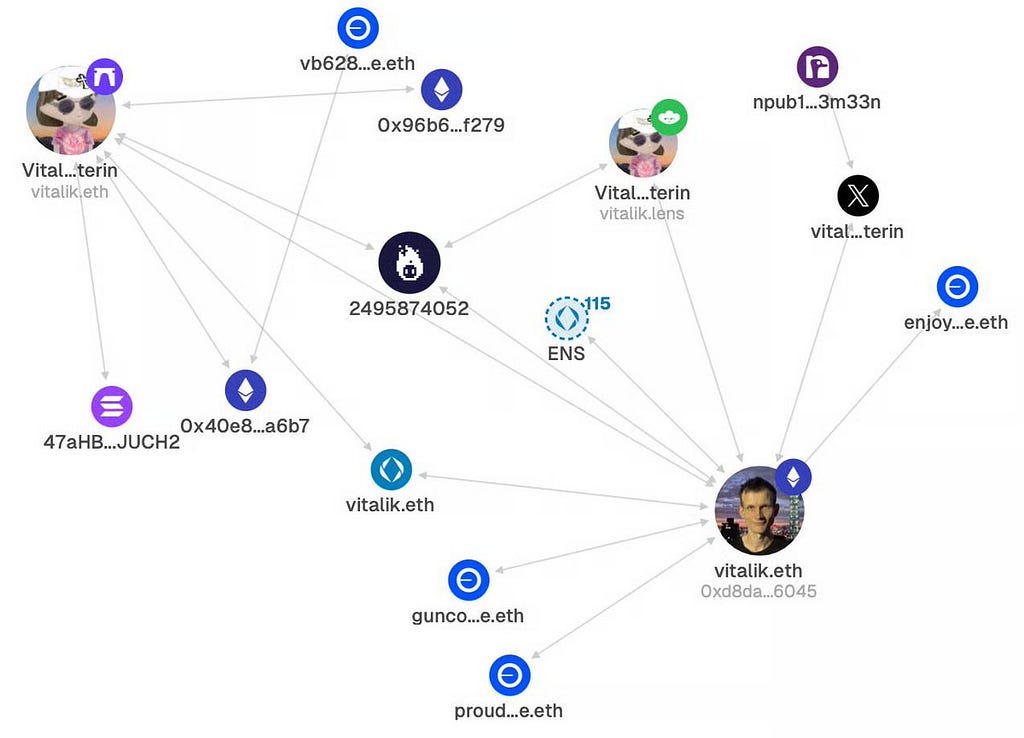
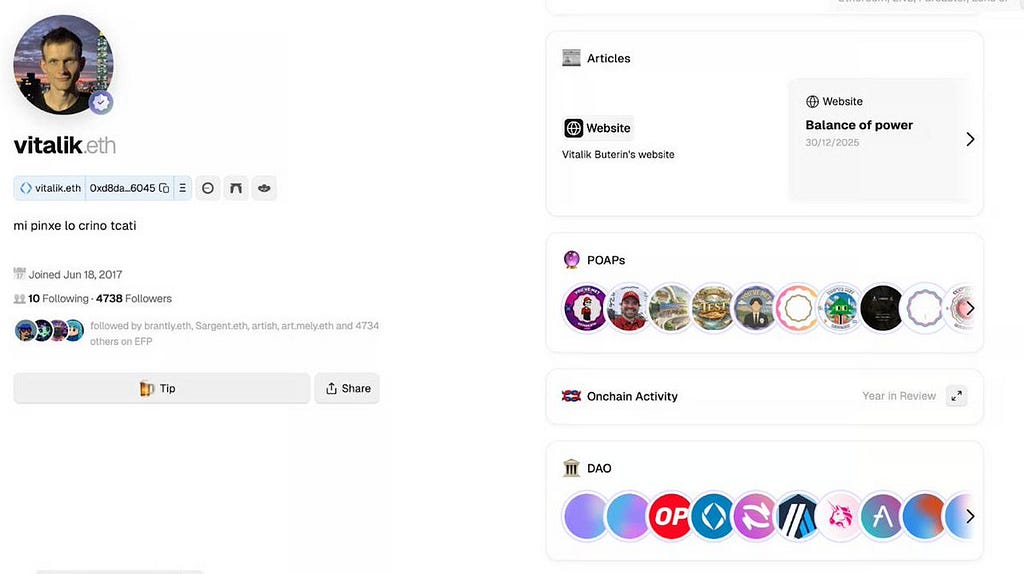
Regarding the “proof of humanity” layer, Web3.bio has adopted a pragmatic aggregation route. Currently, the platform has successfully integrated KYC data from compliant exchanges like Binance and Coinbase, using wallet connectivity as the initial verification entry point. Yet, this is merely the first step in constructing a broader identity network. Through a recent strategic partnership with the decentralised identity protocol Sign, Web3.bio aims to continuously aggregate multi-dimensional, highly reliable verification signals, transforming identity data into reusable infrastructure rather than one-off submissions.
The significance of this model lies in its technical blueprint for onchain KYC to evolve from repetitive document uploads into reusable credential-based verification. For developers, a single API call can verify both a user’s authentication status and identity graph, eliminating the need to rebuild KYC workflows from scratch. For users, control over identity data is restored, enabling selective disclosure. This reputation system, balancing efficiency with privacy, may just be the critical key needed for consumer crypto applications to scale.
3.2 Community Engagement: Lightweight, Gamified, High-Frequency Interaction
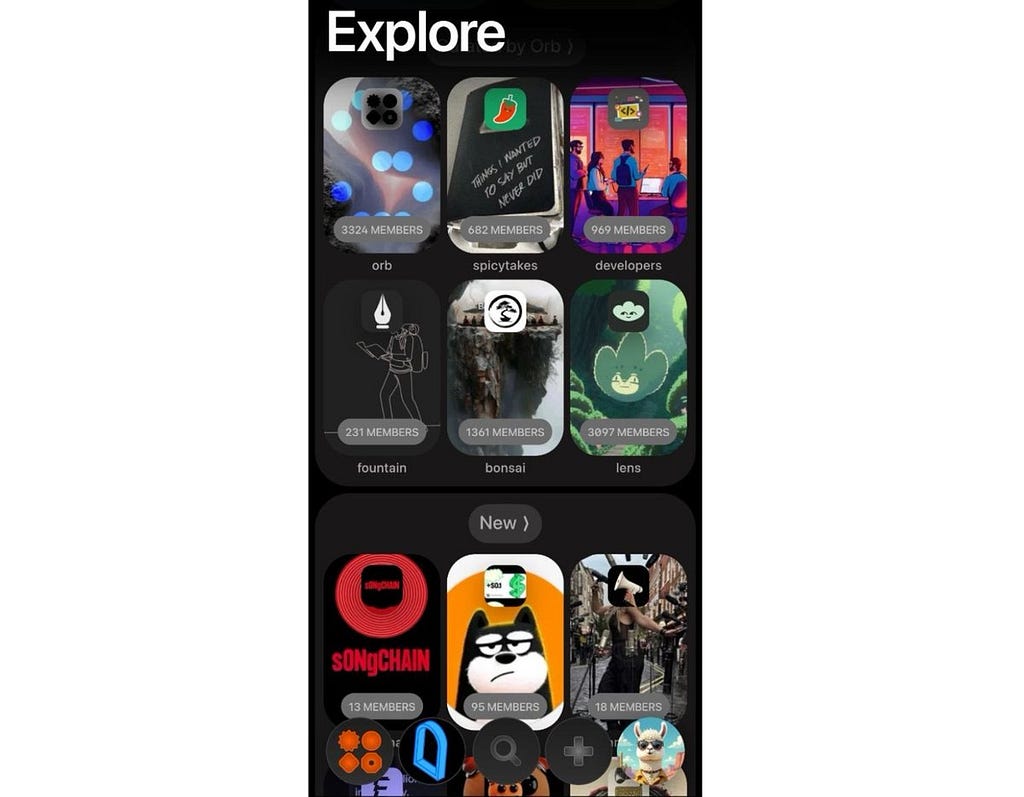
A verified identity is only the starting point. Trust needs context and depth. In the Web2 world, a person’s consumer influence could be inferred from social media check-ins, follower counts, or online engagement. Whereas, in Web3, that depth is built through a user’s day-to-day participation within niche interest communities. One product that captures this idea well is Orb, a social app built on the Lens protocol with more than 50,000 monthly active users. Instead of layering on complicated financial mechanics, Orb focuses on making interaction feel effortless and native to online culture: posts can be minted into digital collectibles, conversations are driven by sticker packs, and tipping is seamlessly embedded into the experience.
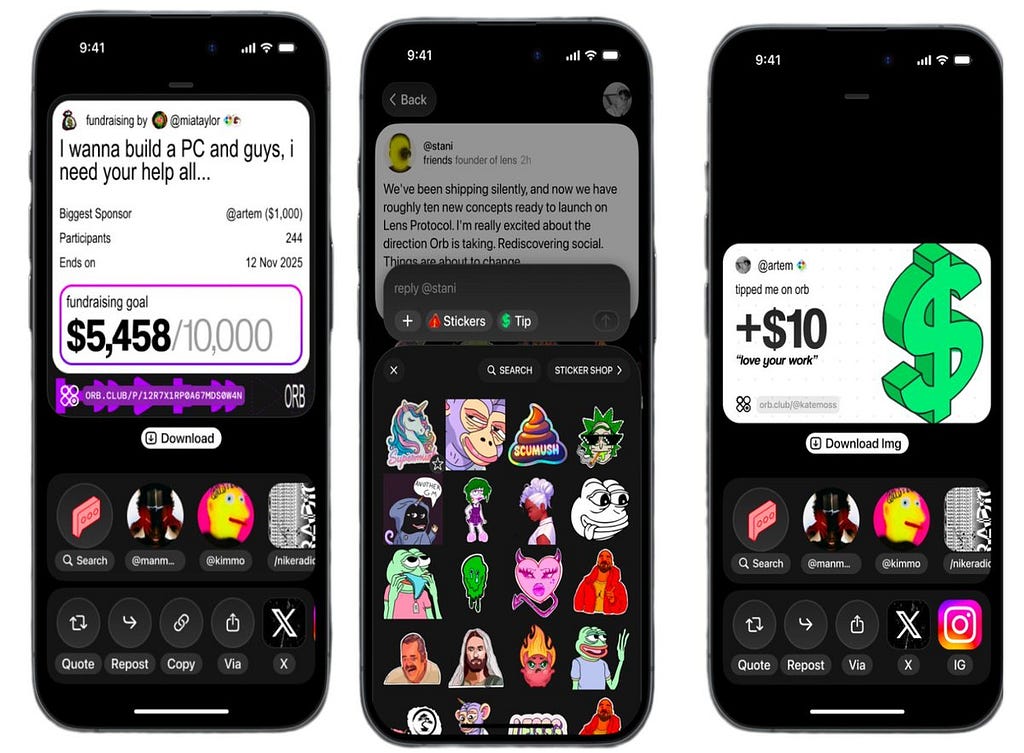
Its most community-oriented feature is Orb Clubs, where users can form small, interest-based communities around topics like electronic music or photography, complete with their own governance rules, and eventually manage a shared community fund. Within these spaces, a user’s posting frequency, contribution level, and social role gradually become measurable signals of both community reputation and cultural influence.
3.3 Information Flow: Merging Prediction Markets and Social Timelines
Once identity is verified and community engagement is established, the final puzzle piece is judgment. In consumer contexts, a user who consistently predicts restaurant trends accurately or demonstrates sharp insight in community votes carries inherently more weight in their recommendations.
Firefly addresses this by merging social feeds and onchain activity into a single timeline. As a Web3 social aggregator, Firefly unifies content streams from X, Farcaster, Lens, and Bluesky, while simultaneously embedding onchain actions, such as Polymarket predictions, Snapshot governance votes, and NFT collection, directly into the interface.

In early 2026, Vitalik Buterin publicly shared that all of his reading and posting activities were conducted through Firefly, spanning multiple protocols.
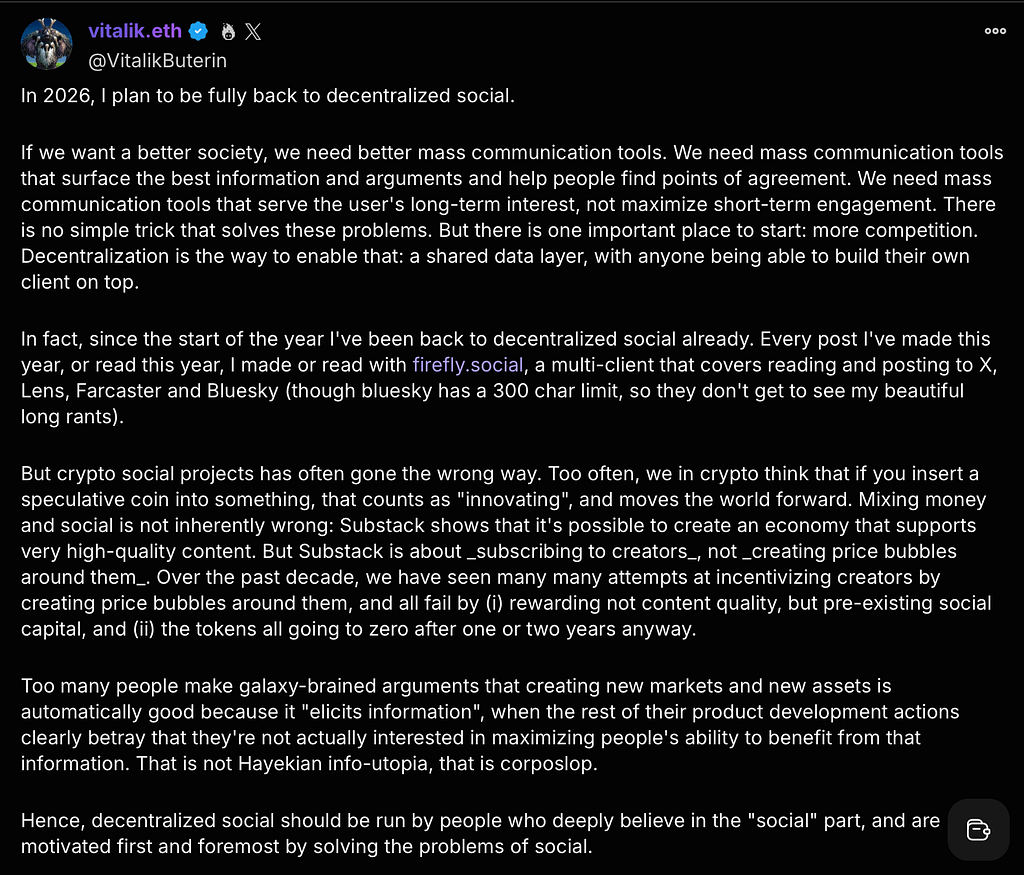
The significance of this design lies in how it transforms online opinions into publicly verifiable reputation signals. On traditional platforms, a claim like “this restaurant will blow up” is just a disposable post. On Firefly, the same assertion, backed by a verifiable Polymarket position, becomes an auditable, onchain prediction.
For consumer applications, this changes how high-value users can be identified. Instead of evaluating purely based on spending volume, platforms can also measure the historical accuracy of their judgments and recommendations. Information feeds therefore evolve from passive content consumption into active reputation accumulation.
3.4 The Trust Triangle: Connecting Identity, Reputation, and Consumption
By weaving these three dimensions together, a seamless pathway to consumer crypto emerges.
Imagine a user who has aggregated and verified their identity through Web3.bio, is an active member of a music-focused Orb Club, and has accumulated a strong record of accurate public predictions on Firefly. When this user walks into a restaurant within the Blackbird network, the terminal scans his or her wallet, instantly cross-referencing verified credentials and social reputation to automatically unlock 5x $FLY rewards. He or she then settles the bill via Ether.fi Cash, drawing directly from staking yield. Post-meal, he or she publishes a review on Firefly, syndicates it across multiple social protocols, mint it as an NFT, and collect tips from his or her Orb community.
In this model, consumer credit is no longer monopolised by a single platform. Instead, it is synthesised from user behaviour across multiple decentralised applications that are fully portable and composable. Merchants, meanwhile, bypass the recurring cost of purchasing traffic from centralised intermediaries, as their “high-value consumer” profile is dynamically constructed from aggregated onchain signals.
3.5 Can This Solve the KYC Bottleneck?
Returning to the core friction point for crypto card users: the tedious, privacy-compromising cycle of repeatedly submitting passports and proof of address for every new application. The aforementioned model provides a viable alternative. If issuers adopt credential-based verification, where users present a verified credential supplemented by robust social reputation backing, rather than uploading raw identity documents each time, the friction of KYC could drop by an order of magnitude.
Progress is already underway: Web3.bio has integrated KYC data from compliant exchanges like Binance and Coinbase, and is exploring NFC passport scanning combined with biometric authentication with Sign. Parallel efforts from Polygon ID and zkPass are advancing similar primitives, while Firefly’s integration of Polymarket and Snapshot provides the missing reputation guarantee layer.
Critically, a user with strong onchain judgment and established community standing typically carries a lower risk profile than a wallet with zero social footprint. These signals can serve as auxiliary inputs for risk models, enabling tiered KYC workflows alongside traditional compliance checks.
Naturally, this does not imply an immediate replacement for statutory identity verification. In strictly regulated scenarios, issuers will still be required to perform full due diligence. However, onchain identity and social reputation can function as a complementary layer, reducing redundant submissions and enabling lighter-weight verification for low-value, low-risk consumer scenarios.
In the long run, the question is not whether decentralised social can instantly replace Web2 platforms, but whether it can offer a user-controlled, selectively disclosed, multi-context reusable identity framework within high-compliance environments. Compared to endlessly reuploading passport scans, this vision aligns far more closely with the internet’s original promise of digital identity.
4. Looking Ahead: When AI Starts Spending on Your Behalf
The previous three sections outline a clear path: crypto cards unlock payment channels, consumer applications reshape everyday activities like dining and ticketing, and decentralised social applications attempt to provide a low-friction trust layer for both. Together, they make a new reality possible: onchain assets can be spent like cash, and consumer reputation can be carried from place to place like credit.
Looking further ahead, this architecture may not be designed solely for human consumers. A parallel technological trajectory is accelerating alongside it.
4.1 When the Payer Is No Longer Human
A notable shift in 2026 is the evolution of AI agents from auxiliary tools into independent initiators of payment activity. Morph predicts that by 2027, AI agents will surpass humans as the largest source of stablecoin transactions onchain. Today, over 400,000 autonomous agents with purchasing capability are already operating globally, with the vast majority settling in USDC. These agents call APIs, rent compute resources, and pay micro-fees for discrete tasks, often at extremely high frequency and microscopic transaction sizes, a scale traditional card networks and banking rails were never designed to handle. Visa’s research paper labels this trend as “Agentic Commerce”. As Coinbase’s Jesse Pollak noted in a CoinDesk interview: “Agents are defined in software and operating software, they want money as software”. In that sense, crypto infrastructure, by design, becomes the natural settlement layer for this emerging paradigm.
Yet a direct challenge follows: how do you KYC an AI agent? Traditional “KYC” frameworks assume a natural person as the counterparty. When the paying entity becomes a smart contract or AI agent, that premise collapses. To address this, MetaComp unveil the StableX KYA (Know Your Agent) framework at the Money20/20 Asia Bangkok conference in April 2026, reportedly the first governance framework for AI agents in regulated financial services. It defines how agents are identified, authorised, monitored, and held accountable across payments, compliance, and wealth management scenarios.
This development underscores a critical insight: the identity infrastructure discussed earlier, namely onchain biometric verification, cross-protocol identity aggregation, decentralised social reputation, may become even more essential in the AI era. The only difference is that the verification target expands from human consumers to any onchain entity executing autonomous behaviour.
4.2 The Reconverged of the Three-Layer Stack
Introducing AI agents into the earlier framework reveals new significance in consumer crypto’s three-layer structure (payments, scenarios, identity).
Firstly, crypto cards and stablecoin rails provide the low-friction settlement layer AI agents require. Circle’s Nanopayments solution, launched in March 2026, was built specifically for high-frequency, micro-value agent-to-agent payments,. By batching off-chain transactions and settling them periodically onchain, it enables USDC transfers as small as $0.000001 with zero gas fees. Similarly, Stripe has built USDC payment infrastructure for AI agents atop the x402 protocol, allowing developers to charge agents $0.01 per API call. These primitives enable fully automated comparison, booking, and payment flows — capabilities that traditional banking APIs and card clearing systems struggle to support at scale.
Secondly, the onchain consumption records and contextual data accumulated by consumer crypto applications become critical training and constraint inputs for AI agents: an agent must know who it represents, in what context, and with what spending authority.
Thirdly, decentralised identity and social reputation may evolve from a “KYC machine” into a trust-scoring engine, where both human and agent behaviour can be traced, evaluated, and tiered onchain.
One possible future scenario could be: a user delegates a monthly stablecoin allowance to their AI agent, authorising it to book preferred restaurants, secure early-bird festival tickets, or filter verified NFT tickets on secondary markets while automatically excluding counterfeit risk. The underlying components for these workflows are no longer theoretical. Early versions of these components already emerging.
4.3 From Speculative Asset to Real Value
Returning to the present, the most urgent question for consumer crypto is still how humans will use it, trust it, and follow the rules. Crypto card users still navigate repetitive KYC submissions; consumer applications continue persuading brands that onchain loyalty is more than a gimmick; and onchain identity remains in early integration, far from broad interoperability. The rise of agentic payments may accelerate infrastructure evolution, but it will not bypass these unresolved frictions — it will only intensify the urgency to solve them.
Viewed through this lens, the core thesis of this report — how payment rails, consumption scenarios, and decentralized identity can converge to transform KYC from a friction point into a user-controlled trust service — applies not only to today’s human consumers, but potentially to the AI agents they authorize tomorrow.
Zooming out, however, the industry has already crossed a critical threshold. Between 2023 and 2026, the defining metric shifted from market-cap volatility to real-world utility: cryptocurrency is finally intersecting with everyday commerce. When dinner at Haidilao settles via Bybit Card, concert tickets issue as on-chain NFTs, restaurant rewards flow across merchants, and spending history becomes portable reputation, crypto asset class quietly transitions from speculative instrument to medium of value. Even though a badly designed tokenomic can still crash a project’s market cap in two days, and fragmented multi-chain liquidity across different blockchains continue to test the abstraction capabilities of front-end applications, the path forward for converging payments, consumption, and identity is no longer a blur.
Consumer crypto does not seek to build a parallel world for technologists alone. Its aim is simpler, and more profound: to reduce real-world transaction costs and make trust easier to establish through cryptographic ownership, stablecoin liquidity, and disintermediated protocols. This effort begins with human consumers and will inevitably extend to the AI agents they empower. Who knows, years from now, 2025–2026 may well be remembered as the inflection point when cryptocurrency stepped beyond exchanges, into ordinary wallets, and began weaving itself into the fabric of daily life.
【免责声明】市场有风险,投资需谨慎。本文不构成投资建议,用户应考虑本文中的任何意见、观点或结论是否符合其特定状况。据此投资,责任自负。