



Intro
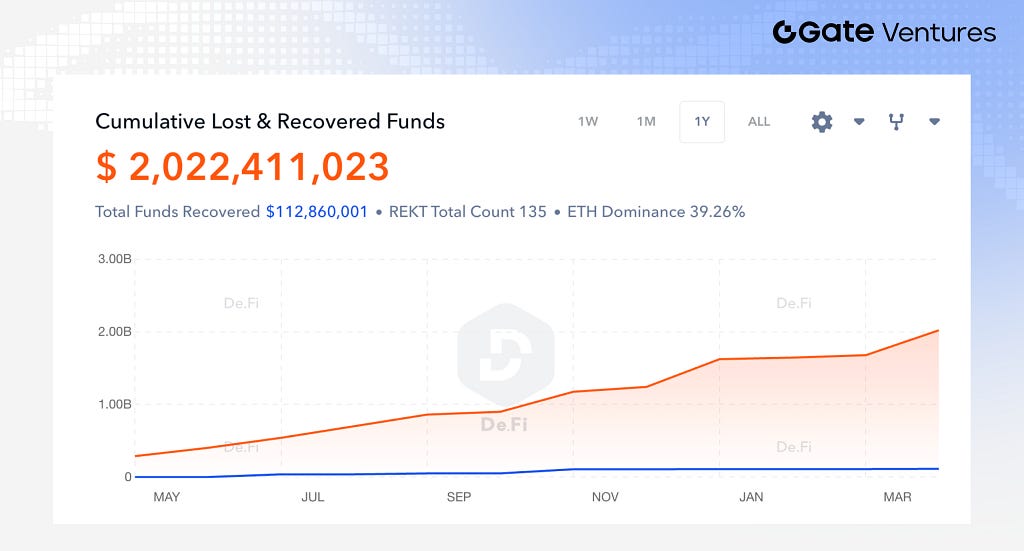
Over the past year, cumulative losses in the DeFi sector have reached $2.02 billion, with only about 5% of funds ultimately recovered. That figure is roughly 1.1× Curve Finance’s TVL, demonstrating that security incidents continue to erode the industry’s capital base.
Since March of this year, the DeFi sector has seen several notable security incidents:
Solv Protocol lost $2.73 million due to a repeated-minting vulnerability in its mint() function. Venus Protocol on BSC incurred $2.18 million in bad debt after a supply-cap verification gap was bypassed. Resolv Labs suffered the unauthorized minting of approximately $80 million in uncollateralized USR following a private key leak, ultimately resulting in around $25 million in capital losses. Drift Protocol experienced the largest attack of 2026 to date, with losses exceeding $280 million; the attacker had prepared the attack path several weeks in advance, then obtained 2-of-5 multisig approval via social engineering, eventually taking over administrative permissions and transferring more than half of the protocol's funds in a short window. KelpDAO also experienced rsETH risk spillover and a liquidity squeeze tied to an underlying asset security incident, further amplifying LRT-related market pressure.
These events expose a harsh reality: no matter how advanced the underlying technology is, user funds are always exposed to tail risks that cannot be fully eliminated.
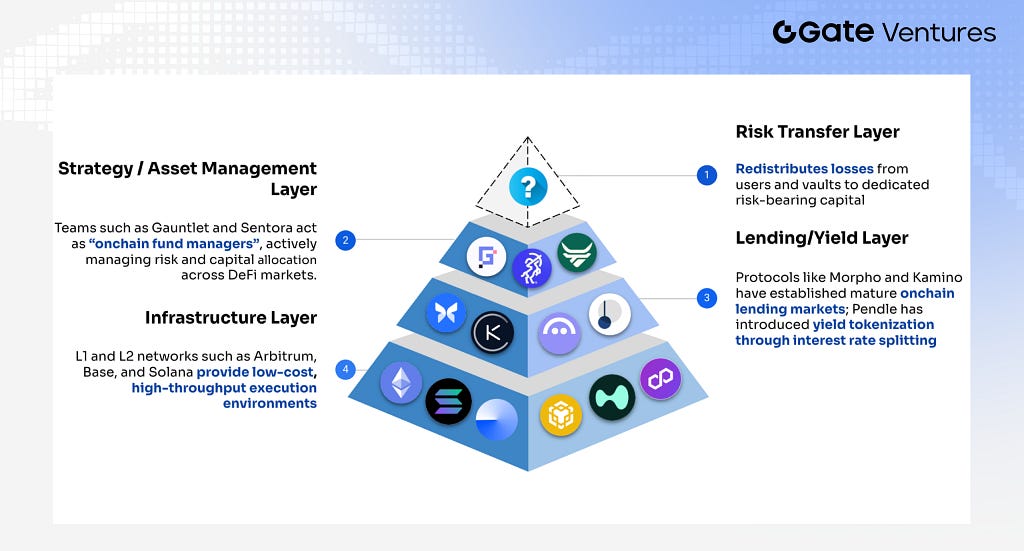
In other layers, DeFi has actually built a solid foundation over the past few years:
- Infrastructure Layer: Ethereum completed The Merge, and L1/L2s like Base and Solana continue to provide low-cost, high-throughput execution environments. The stability and reliability of on-chain settlement have gradually approached those of traditional financial infrastructure.
- Lending / Yield Layer: Protocols like Aave, Morpho, and Kamino have built a relatively mature on-chain lending market, while Pendle further enables interest rate stripping, making yield products increasingly diverse.
- Strategy / Asset Management Layer: Professional risk management teams like Gauntlet, Steakhouse Financial, and MEV Capital have begun participating in the market as “on-chain fund managers,” actively managing both risk and yield.
Even so, the DeFi stack still has a clear gap on one critical front: “risk transfer.”
Benchmarking TradFi: The Absence of an Insurance Layer
The traditional financial system can support hundreds of trillions of dollars in assets, relying not only on regulation but also on a comprehensive risk transfer mechanism: bank deposits are protected by the FDIC, securities accounts are backed by SIPC, and institutional trades are hedged with credit derivatives.
As the “shock absorber of the financial system,” the global insurance industry generates premium income equivalent to roughly 6–7% of global GDP. Once you factor in the asset management scale held by insurance companies, their influence on capital markets far exceeds that ratio. (1)
By comparison, the premium volume of on-chain insurance products is less than 1% of DeFi TVL, and the gap itself signals the scale of the market opportunity.
Why Is DeFi Insurance So Difficult?
1. Risks are difficult to model with actuarial methods, and traditional insurance pricing frameworks are not directly applicable.
The risks DeFi faces are highly complex and heterogeneous, including smart contract vulnerabilities, stablecoin depegs, and oracle failures. These risks often coexist and compound. Unlike traditional insurance, DeFi lacks long-cycle, verifiable historical claims data, which makes it difficult for traditional actuarial models that rely on long-term loss distributions and incident frequencies to function effectively.
Meanwhile, the boundaries of DeFi risk are far more ambiguous than those in traditional insurance. In traditional insurance, insured objects such as houses, vehicles, or individuals typically have clear, independent risk boundaries. In DeFi, however, protocols are highly composable, so the failure of a single underlying component often propagates through liquidity, collateral, yield strategies, and liquidation paths, resulting in cross-protocol chain losses. This makes it harder to define the scope of coverage, assign responsibility, and quantify losses.
2. Capital efficiency is relatively low, making it hard to compete with native DeFi yields.
The insurance business fundamentally requires large reserves to be locked in advance to cover potential claim liabilities. In the DeFi ecosystem, however, users and liquidity providers tend to allocate funds to strategies that continuously generate higher yields, such as lending, market making, arbitrage, and yield aggregation.
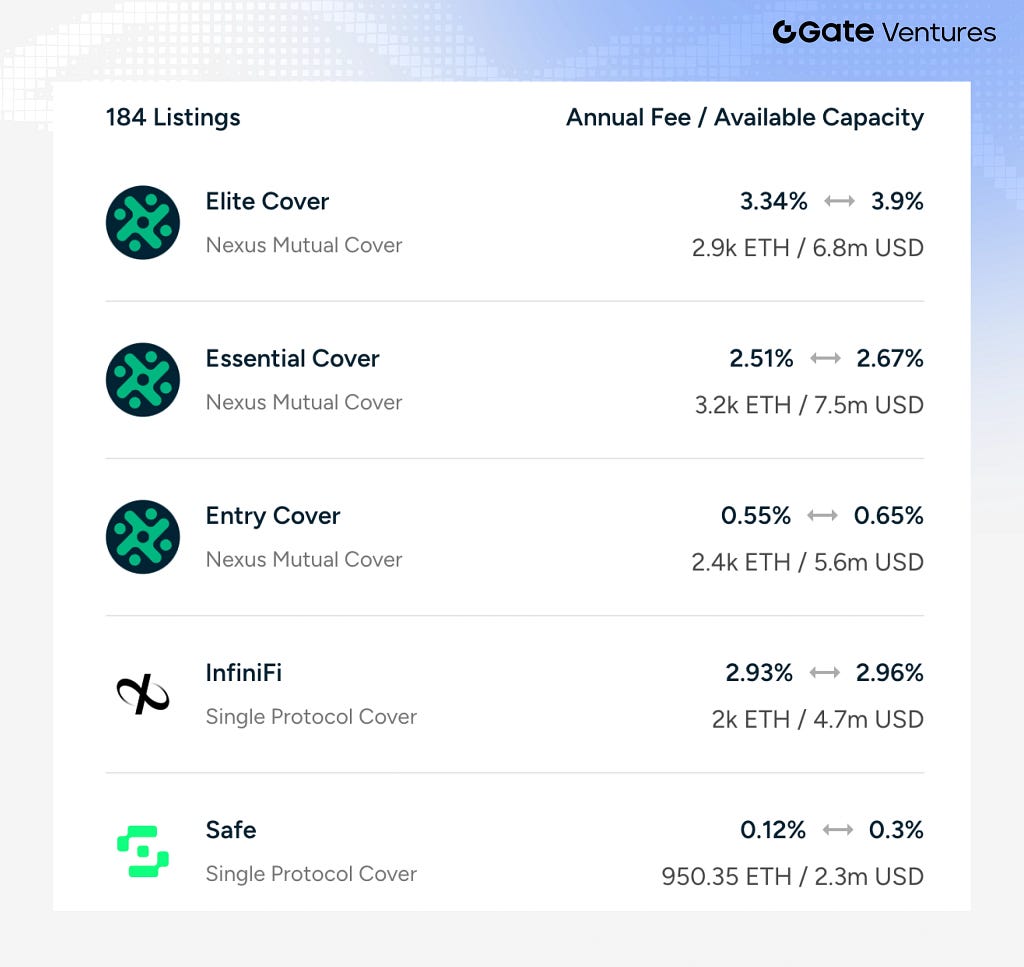
By comparison, the returns offered by most current on-chain insurance pools are generally lower than mainstream DeFi yields, making it hard to compete with these more attractive capital uses. Under such opportunity cost constraints, insurance pools often struggle to consistently attract sufficient underwriting capital, further limiting the supply depth and scalability of insurance products.
Sector Analysis
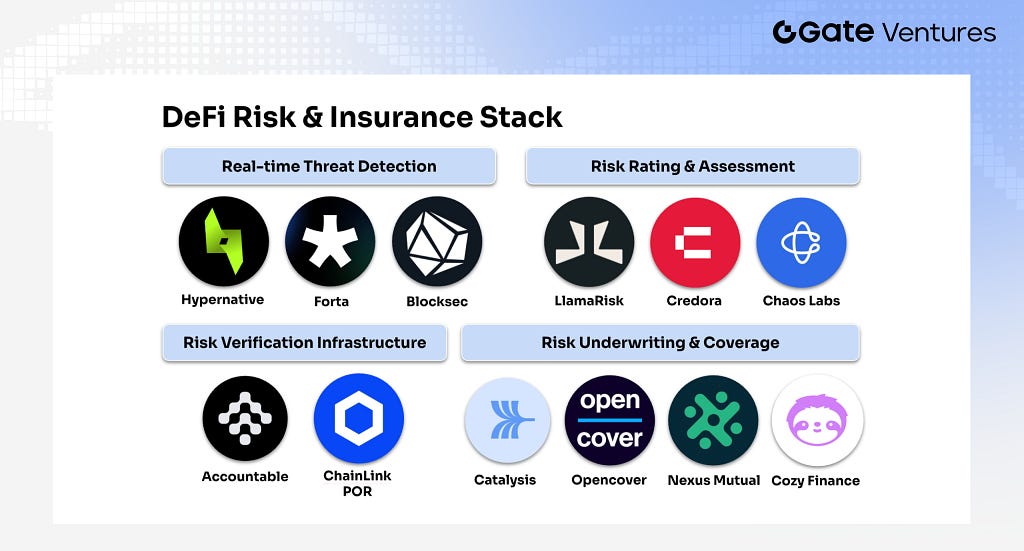
Despite this gap, we have already begun to see the initial emergence of insurance and risk ecosystems on-chain.
On one end are underwriting capital pools like Nexus Mutual that truly take on risk transfer functions. On the other are platforms like Catalysis and OpenCover, which embed protection mechanisms into deposit and product pathways, supported by risk ratings from Credora and LlamaRisk, risk verification from Accountable, and real-time risk detection from Hypernative and BlockSec.
First, let’s define the four functional layers:
- Coverage / Underwriting is what ultimately absorbs losses, collects premiums, and determines payouts, embedding protection natively into the vault or product workflow so that coverage is no longer an add-on.
- Risk Rating converts risk into comparable scores, capital recommendations, and parameters.
- Verification confirms whether assets, liabilities, and reserves truly exist and can be verified on-chain.
- Detection provides alerts, transaction screening, simulation, and auto-blocking before a loss occurs.
These four layers together form the analytical framework of this article.
Insurance / Underwriting Layer
The core design of Catalysis is to embed risk protection directly into the DeFi vault, making protection part of the asset allocation path rather than an external insurance product users need to purchase separately. In other words, when users deposit funds into the vault, they automatically receive corresponding risk protection without having to seek out a separate insurance protocol.
Mechanically, Catalysis connects three types of participants into a complete on-chain underwriting flow:
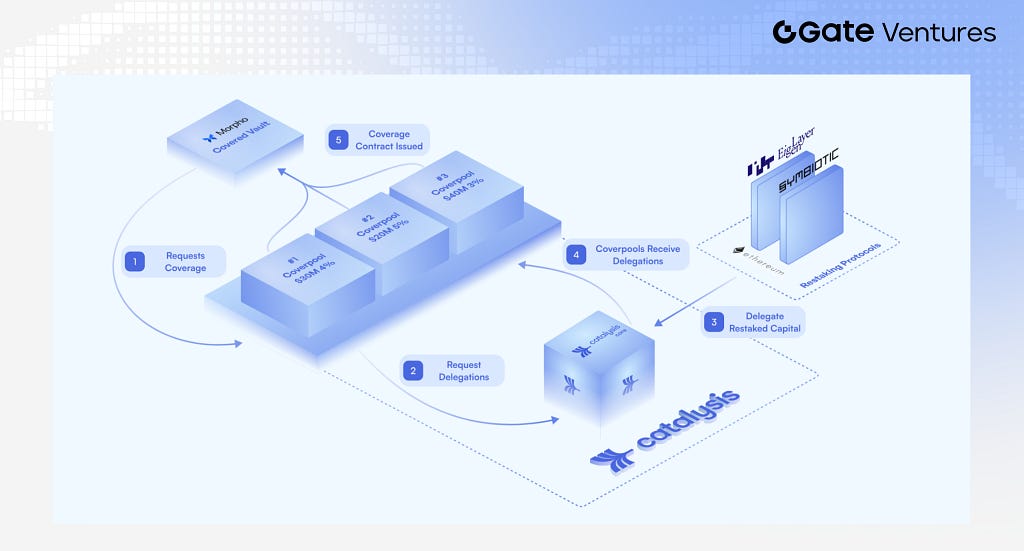
First, restakers deposit ETH, BTC, or stablecoins into restaking protocols like EigenLayer and Symbiotic, creating a slashable economic security capital pool that forms the system’s initial underwriting capacity. Next, this capital is allocated across different CoverPools, each CoverPool corresponding to a specific type of risk such as a particular lending vault or yield strategy. Finally, vault users pay coverage fees as the cost of obtaining risk protection, and these fees are distributed to the restakers providing underwriting capital. (2)
How is risk priced?
In Catalysis, risk pricing is not determined case by case by an insurance committee. Instead, it is automatically executed through a set of parameter models preset by the protocol team. The general logic: the higher the risk, the more slashable underwriting capital needs to be allocated, and the higher the corresponding protection fee.
Specifically, each CoverPool sets underwriting capacity, slashing ratio, and fee rate parameters for different types of vault risk. These parameters determine how much restaked capital must be locked as protection and how much coverage fee users need to pay. Essentially, these fees represent the cost of “renting underwriting capital.”
At the same time, since underwriting capital comes from restakers, the fee rate is also affected by capital supply: when available underwriting capital is sufficient, protection costs are lower; when capital is scarce, the fee rate rises. This means risk pricing is determined both by protocol parameters and by the supply and demand of funds in the market.
OpenCover also falls under “embedded protection infrastructure,” but it is not the final underwriter. Rather, it functions more as a distribution and structuring platform for on-chain protection products, responsible for packaging underlying underwriting capabilities into modular protection bundles that can be directly integrated into DeFi product pathways. (3)
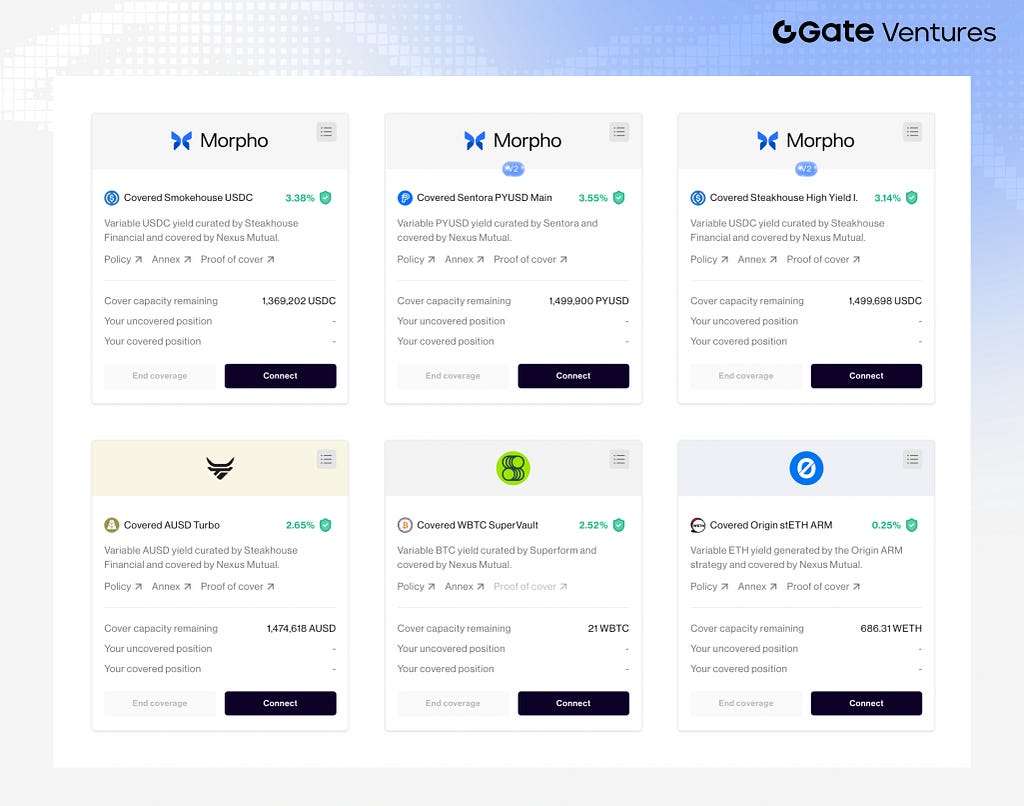
In terms of underwriting structure, OpenCover itself does not provide underwriting capital.
The actual coverage behind Covered Vaults is provided by Nexus Mutual. When users deposit vault shares, Nexus Mutual’s staking pool locks the corresponding amount of NXM in real time based on the coverage size, serving as on-chain verifiable underwriting capital. This allows coverage capacity to scale in sync with the vault’s risk exposure.
For risk pricing, the fee rate for Covered Vaults is not fixed. Instead, it follows Nexus Mutual’s dynamic pricing mechanism.
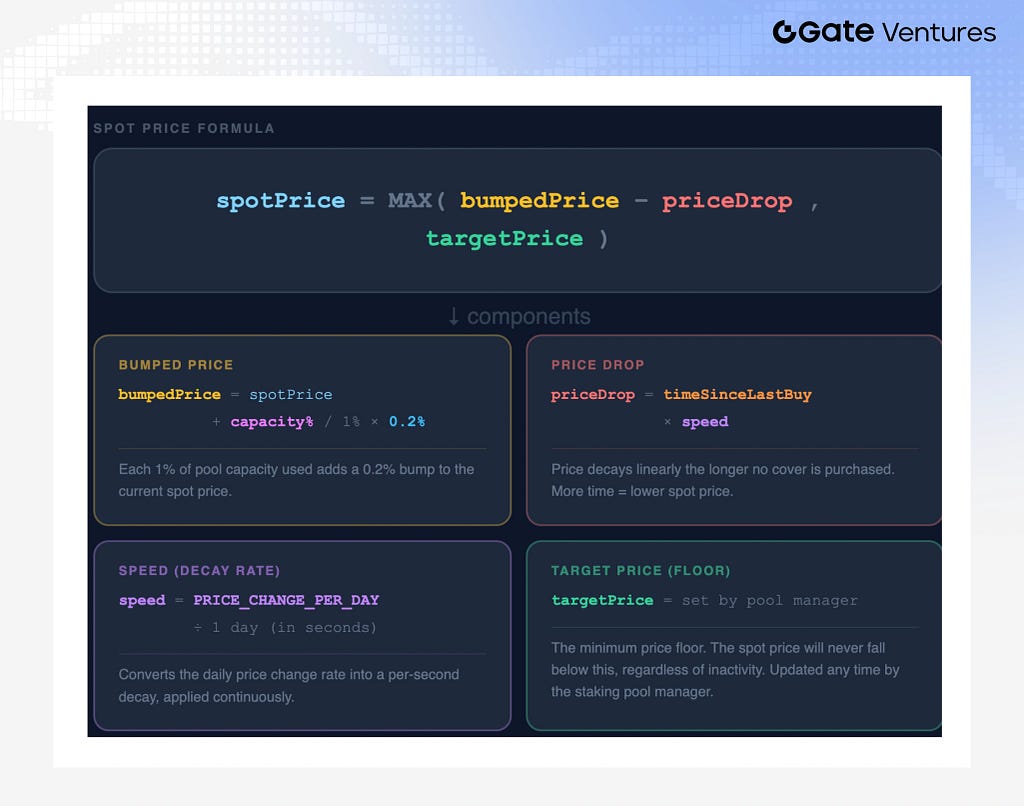
Simply put, the underwriting pool manager first sets a minimum acceptable fee rate, then adjusts around that initial price based on supply and demand: when protection demand for a vault rises rapidly and underwriting capacity is heavily utilized, the price automatically increases; conversely, when capacity is sufficient and demand is low, the price gradually decreases. Overall, this is an on-chain pricing mechanism that dynamically responds to risk and capital utilization. (4)
Risk Assessment Layer
Several institutions focused on DeFi risk assessment have emerged in the market, approaching from three different angles: credit scoring, verifiable data infrastructure, and dynamic parameter simulation. Together, they form an important foundation for on-chain insurance pricing and risk management.
Credora is currently the DeFi quantitative risk scoring system closest to traditional credit rating agencies such as S&P and Moody’s. Launched by RedStone, it specializes in systemic risk rating for tokens, lending markets, and vault portfolios, providing protocols with a quantifiable basis for capital allocation.
Three-Tier Rating Framework
1. Token Rating
Calculates probability of default (PD) for assets such as LSTs and stablecoins. Uses a benchmark anchoring methodology combined with risk adjustment factors to generate a base risk score.
2. Lending Market Rating
Distinguishes between different market structures:
- Isolated collateral markets (e.g., Morpho): Uses Monte Carlo simulation to model a large number of random scenarios, repeatedly inferring how an event might unfold and ultimately estimating the probability distribution of outcomes. The main focus is whether the market would experience significant losses if a particular collateral encounters an issue.
- Cross-collateral markets (e.g., Aave, Spark): These have a more complex structure, because the same type of asset can be repeatedly borrowed and used as collateral again, causing risk to compound layer by layer. The key assessment is whether, if the underlying assets encounter issues, this chain of usage could amplify the risk and ultimately impact the entire market. (5)
3. Portfolio Rating
Views the vault as a cross-market asset portfolio that, in addition to underlying allocation, also incorporates manager capabilities and the quality of the governance structure.
Rating Method
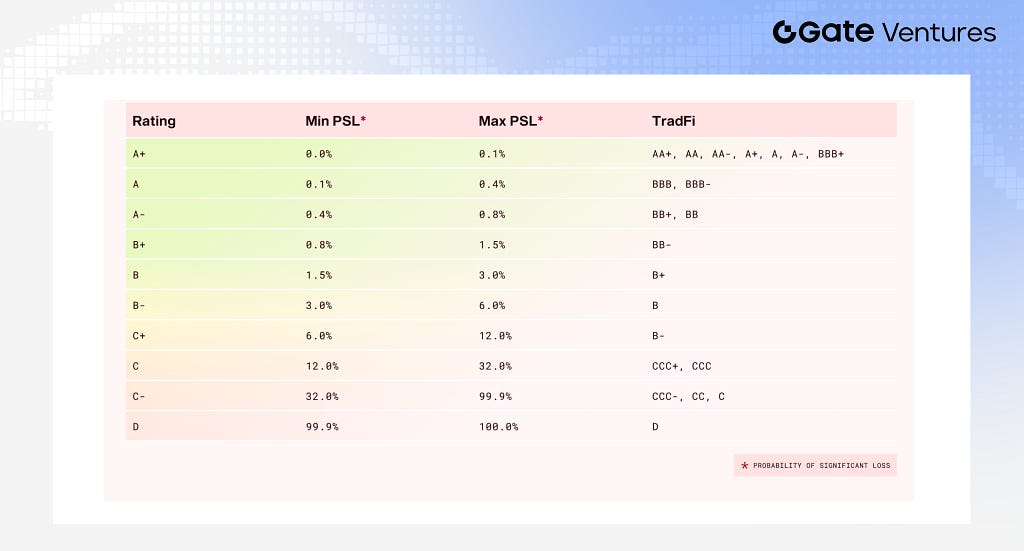
Using an A+ to D letter rating system based on historical default rate data from the three major rating agencies between 1990 and 2023, and constructing a PD curve via an exponential function, traditional credit ratings can be mapped to DeFi risk distribution ranges.
Unlike Credora, LlamaRisk’s core focus is not scoring but establishing a verifiable, on-chain risk data framework that addresses one of the most critical issues in DeFi: data reliability.
Two Core Components
SAVE Framework (Structured Attestation & Verification Engine)
An open-source TypeScript toolkit for converting structured financial data into verifiable on-chain records, including:
- Claims: Structured factual statements
- Proofs: Cryptographic proofs
- Attestations: Signed evidence published on-chain and stored in IPFS
Applicable scenarios include proof of reserves, collateral quality verification, and strategy transparency.
LlamaGuard Suite
An RWA risk management toolkit built on SAVE:
- LlamaGuard Proof: Automated financial data attestation
- LlamaGuard NAV: Chainlink-based bounded NAV oracle
- LlamaGuard Actions: Conditional trigger risk response mechanism (6)
Multiple protocols including Aave, Curve, Midas, and Ethena also use this information to assess risk factors such as liquidity conditions, changes in utilization rate, and oracle price deviations. These insights help teams set reserve sizes, debt ceilings, and other key risk parameters with greater confidence.
Chaos Labs is currently one of the most broadly covered DeFi risk analytics platforms, focused on real-time simulation, market stress testing, and risk parameter optimization.
Three Core Capabilities
First, dynamic risk monitoring: Tracking key protocol metrics in real time across multiple chains, including total supply and lending volume, utilization rate, liquidation events, and collateral concentration and whale address risk exposure. Its monitoring range currently covers over $63.7 billion in asset supply across multiple major public chains.
Second, risk exposure simulation: Stress testing for extreme market scenarios such as sharp drops in collateral prices, rapid liquidity contraction, or concentrated sell-offs of a single asset, to assess the protocol’s solvency and potential bad debt risks under these conditions.
Third, parameter optimization: Making adjustment recommendations for key protocol risk parameters based on simulation results, such as LTV, liquidation thresholds, and interest rate curves, to help the protocol achieve a better balance between capital efficiency and risk control. (7)
Verification Layer
The verification layer addresses a more fundamental question: whether on-chain data is truly authentic and reliable.
Without reliable mechanisms for verifying assets, liabilities, and reserves, even the most sophisticated risk models may be built on incorrect assumptions. In the current market, the most representative verification infrastructures include Chainlink Proof of Reserve and Accountable.
Chainlink PoR is currently one of the most mature on-chain reserve verification networks, primarily used to verify whether stablecoins, cross-chain assets, and RWAs are fully collateralized. Its core objective is to reduce DeFi’s trust risk regarding the authenticity of off-chain assets.
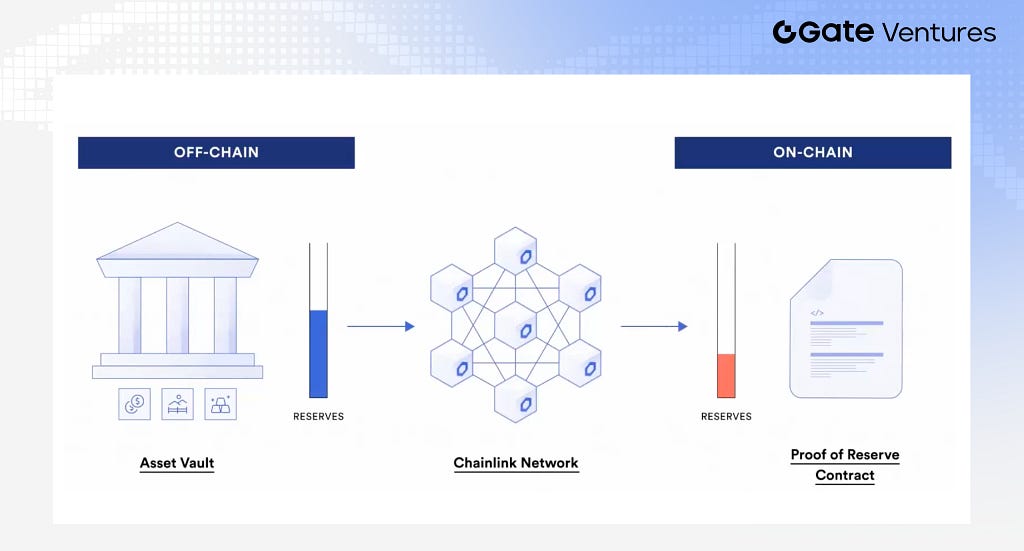
The process can roughly be divided into several steps. First, the auditing institution or data provider continuously collects reserve information. Then the Chainlink decentralized oracle network verifies the data and reaches consensus on it. When reserve changes exceed a preset threshold or a fixed update time is reached, the data is written on-chain for protocols to access directly. (8)
The key value of PoR is that it not only displays data but also connects to protocol logic:
- Secure Mint: New minting is only permitted when reserves are sufficient, preventing uncollateralized issuance.
- Circuit Breaker: When a collateral anomaly occurs, lending or related operations can be automatically paused.
Accountable Capital addresses the core blind spot of traditional PoR: only verifying assets, not liabilities.
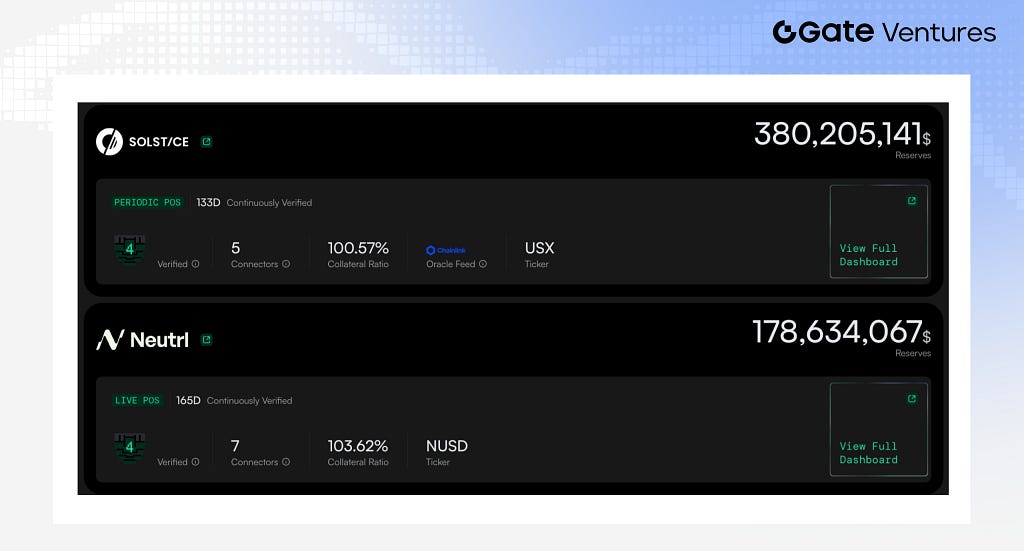
Looking only at assets isn’t enough to prove an institution’s health, since it may still carry larger hidden liabilities. Accountable’s core approach is to use zero-knowledge proofs to verify both assets and liabilities without exposing sensitive information, providing a more comprehensive proof of solvency.
How It Works
Its core architecture, the Data Verification Network (DVN), continuously integrates multiple data sources, including on-chain addresses, custodial accounts, bank accounts, internal accounting systems, and futures positions. After local encrypted processing, it generates ZKPs to prove whether an institution has sufficient net solvency without disclosing specific addresses, API keys, or trading strategies. (9)
Compared to simply checking whether reserves exist, Accountable goes a step further by verifying the overall financial position. This is especially suitable for institutional strategies or stablecoin structures that require ongoing disclosure of leverage, hedge positions, and liabilities.
Risk Detection Layer
The risk detection layer addresses another key question: can attacks be detected and stopped in time before causing losses?
Auditing is a static check performed before deployment, while the detection layer acts as a real-time immune system after the protocol goes live. Currently, one of the most representative infrastructures is Hypernative.
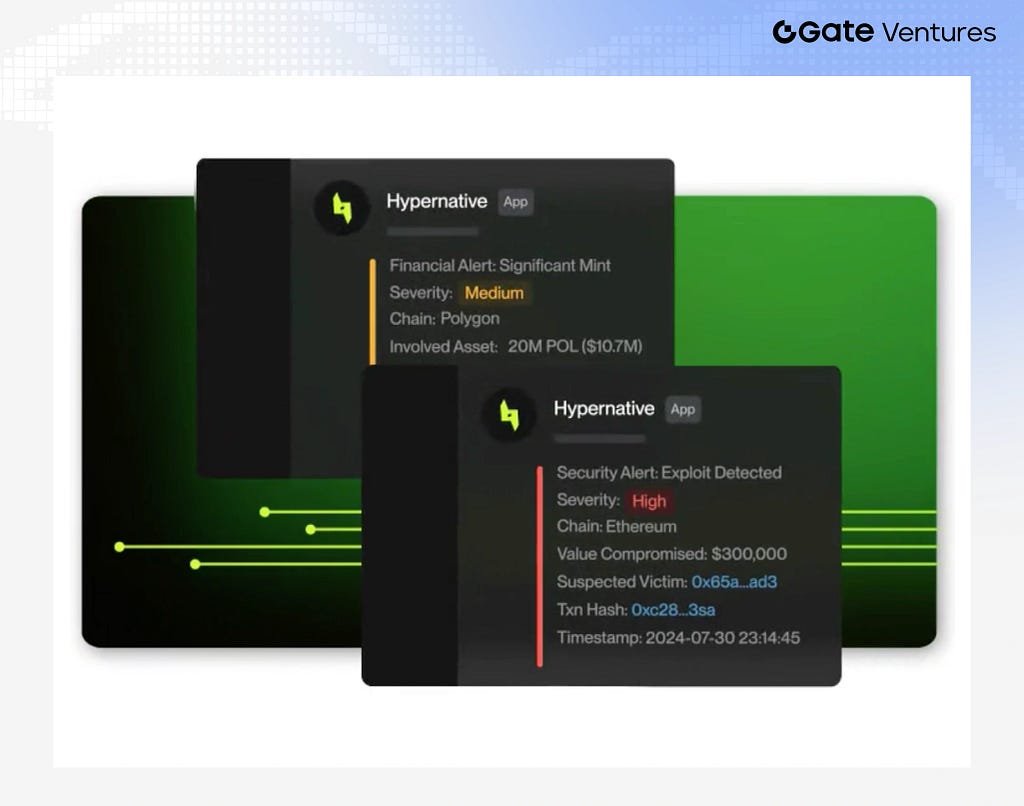
Hypernative’s core capabilities lie in continuously tracking abnormal activity across multiple dimensions through machine learning, transaction simulation, graph analysis, and mempool monitoring. In other words, it doesn’t just check for vulnerabilities in the smart contract itself; it also monitors whether an attack is being prepared, looking for signals like abnormal trade paths, oracle deviations, unusual governance actions, front-end phishing, or cross-protocol behaviors. (10)
The real value of this detection capability lies in its ability to directly trigger automated risk control actions. When the system determines that risk has reached a certain level, the protocol can immediately pause the market, freeze specific functions, adjust LTV or borrow cap, isolate suspicious assets, and even intercept transactions before they are included in a block.
Compared to traditional audits, which can only provide a static report before deployment, these detection systems offer ongoing protection during operation. Audits answer the question “What issues might exist?” while detection answers “Is something happening right now?”
Outlook
For the DeFi insurance market to truly scale, several core issues still need to be addressed.
First, the yield on underwriting capital is currently relatively low and clearly less attractive than other on-chain yield opportunities. Whether it’s lending, market making, or various yield aggregation strategies, capital can often find higher returns elsewhere.
The question then comes back to fundamental supply and demand logic: if the risk compensation earned by the insurance underwriting pool isn’t high enough, who would be willing to provide capital over the long term to take on these tail risks?
Second, for the insurance layer to truly be effective, the underwriting capital pool itself must be large enough to cover losses from medium to large-scale security incidents. For black swan events, potential losses could reach hundreds of millions of dollars.
Of course, the responsibility for risk management shouldn’t rest solely on the insurance side. The protocol itself also needs mechanisms such as timelocks and withdrawal rate limits to minimize the risk of liquidity being drained in a single event. Even so, the insurance capital pool still needs to be of considerable size to provide effective protection.
More importantly, compared to TradFi, security incidents occur more frequently in DeFi and attack vectors are more diverse. This means the capital required for the insurance layer is larger, making expansion naturally harder.
Third, current DeFi protocols still lack sufficient “stop-loss structures” at the system design level, making it difficult for the insurance layer to effectively price risk.
From an insurance perspective, the key question isn’t whether an attack will occur, but whether losses can be structurally limited when one does. In reality, many protocols still allow administrators to transfer large amounts of funds, modify parameters, or even upgrade contracts within a very short window. Once these permissions are compromised, losses are often “instantly realized,” resulting in an LGD (Loss Given Default) close to 100%.
In this structure, the insurance capital is effectively taking on unlimited tail risk, which is nearly impossible to insure commercially.
By contrast, if a protocol introduces these mechanisms at the design level:
- Withdrawal rate limits
- Single-transaction / daily caps
- Preset fund flow whitelists
- Mandatory timelocks
These can significantly reduce the maximum loss from a single attack, shifting risk from “catastrophic” to “measurable,” which is essential for the insurance layer to establish a reasonable pricing mechanism.
Fourth, there are still many “unknown unknowns” in the underlying technical structure of DeFi, which means on-chain protocols remain exposed to constantly evolving new attack surfaces.
Several recent cases are particularly representative: Drift’s issue stemmed from the administrator’s private key being compromised through social engineering, while the KelpDAO incident was related to its 1-of-1 verifier configuration being breached. When receiving cross-chain messages via LayerZero, only a single node was responsible for verification before funds were released, resulting in a critical single point of failure in the system.
Risks like these don’t necessarily stem from code vulnerabilities alone; they can also arise from permission design, cross-chain verification, operational processes, or human error. In other words, on-chain risk management isn’t limited to “known risks”; there are also many potential risks that have yet to be fully identified.
Even though the market already has real-time security monitoring platforms like Hypernative and risk assessment tools like Chaos Labs and LlamaRisk, the overall DeFi risk management framework still needs a longer period of iteration before it can become truly mature and reliable.
Reference:
- https://www.swissre.com/institute/research/sigma-research.html#:~:text=Read%20More%20about:%20sigma%2003,19%20Nov%202024
- https://docs.catalysis.network/docs/coverpools/
- https://x.com/OpenCover/status/2039721567169483046?s=20
- https://docs.nexusmutual.io/protocol/cover
- https://docs.redstone.finance/docs/redstone-credora/
- https://docs.llamarisk.com/
- https://chaoslabs.xyz/analytics
- https://chain.link/proof-of-reserve
- https://accountable.capital/dvn
- https://www.hypernative.io/products/hypernative-platform
About Gate Ventures
Gate Ventures, the venture capital arm of Gate.com, is focused on investments in decentralized infrastructure, middleware, and applications that will reshape the world in the Web 3.0 age. Working with industry leaders across the globe, Gate Ventures helps promising teams and startups that possess the ideas and capabilities needed to redefine social and financial interactions.
Website | Twitter | Medium | LinkedIn
The content herein does not constitute any offer, solicitation, or recommendation. You should always seek independent professional advice before making any investment decisions. Please note that Gate Ventures may restrict or prohibit the use of all or a portion of the services from restricted locations. For more information, please read its applicable user agreement.
【免责声明】市场有风险,投资需谨慎。本文不构成投资建议,用户应考虑本文中的任何意见、观点或结论是否符合其特定状况。据此投资,责任自负。