

Stacy Muur
Twitter
观点

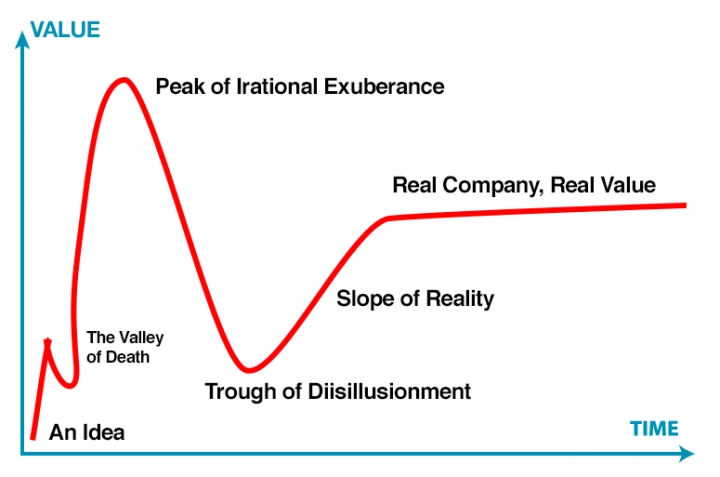
What’s happening right now does feel like crypto going through a brutal correction.
Think about it:
→ Max euphoria
→ Shortcuts get exposed
→ The ecosystem gets a reality check
→ People go back to fundamentals
What happens after?
Well, if history tells us anything, people called these dead too:
- DeFi TVL: $55B (2022) → $270B (2025)
- Stablecoin market cap: ~$120B (2023) → record $251.7B (2025)
- Tokenized Treasuries: $1.3B (2024) → $13.8B (2026)
- DEX market share: 6.0% (2021) → 21.2% (2025)
I know we're hurting rn, but I think this is where the teams with real products start to stand out.
IMO, this is just the beginning.
Why so many hacks recently?
$1.01B lost to hacks in 2026. We're not even through April.
April alone accounts for $577M across just three exploits:
Every major hack this year had one thing in common, the exploit didn't live in the smart contract; it lived in the off-chain layer: private keys, multisig operators, bridge configs, supply chain backdoors.
Opaque off-chain logic is where attackers camp. They're patient, they're thorough, and they've had years to map every trusted operator in your stack. You just don't know it yet.
The answer isn't human-in-the-loop checkpoints; that just adds more surfaces for social engineering.
The answer is moving critical logic onchain, making every assumption explicit, every compromise visible. Not because it's perfectly secure, but because at least then the whitehat community can look without asking permission. AI security tooling can scan it. The attack surface becomes legible.
Immutable contracts + community-controlled emergency pause > upgradeable contracts + trusted operators nobody can fully vet.
Off-chain complexity is where AI-powered attackers will dominate longest. Onchain is where defenders actually have a fighting chance.
Onchain borrowing still feels inefficient.
DeFi lending works like Uniswap V2.
You deposit into a market and accept whatever risk parameters it gives you.
V3 lets LPs pick where along the price curve their capital sits.
This one change made liquidity dramatically more efficient.
DeFi lending never got that upgrade.
Multi-threshold lending might be the missing layer.
• Lenders choose where along the risk curve they're comfortable
• Liquidity stays unified
• Rates reflect actual risk rather than a governance committee's last vote
Instead of one fixed threshold that's either too conservative or too aggressive, the market continuously prices risk across the full spectrum.
It seems DeFi lending could finally get its V3 moment.
Polymarket said back in December that they wanted to leave Polygon and build their own Ethereum L2.
No chain has shipped yet, no date given, but the intent is out there.
The dependency since then has only gotten worse.
March 2026 numbers:
→ 77% of Polygon's gas consumption
→ 67% of gas fees
→ 55% of all transactions
If you look at the bigger picture, Polygon is highly focused on payments. Stablecoin P2P volume is growing completely independently of Polymarket. That growth is real and it has nothing to do with prediction markets.
But, if you look at the economics, a prediction market generates constant, high-frequency transactions that pay priority fees. A stablecoin transfer costs almost nothing in gas. Those two things are not interchangeable. You'd need dramatically more payment activity to produce the same fee revenue that one prediction market app generates today.
Polygon's team says if Polymarket leaves, blockspace opens up, gas adjusts down, and other apps fill the gap over time.
That's reasonable in theory.
But the claim that Polymarket "isn't most of the chain" by transaction count doesn't hold up, it's 55% of all transactions, not just gas.
The payments story under Polygon is legitimate.
But when a single app accounts for the majority of your chain's activity across gas, fees, and transactions, and that app is openly working on leaving, that's not something you can hand-wave with "other apps will fill the gap."
Most crypto tokens are designed backwards.
You make money by selling, not by holding.
Which means every other holder is your competition from day one.
Founders are timing their vesting unlock, investors are timing theirs, and retail is trying to front-run both.
Nobody is actually aligned; everyone is just playing musical chairs.
The fix isn't complicated in theory, if holders earn by holding rather than selling, the incentive flips.
You stop trying to outmaneuver other holders and start trying to grow the protocol. Your competition becomes other protocols, not your own community.
The reason it hasn't happened comes down to two things:
• Distributing revenue to holders looked too much like an unregistered security under existing law. That legal risk killed the idea before it started for most teams.
• The infrastructure to do it cheaply didn't exist. Gas costs on the mainnet Ethereum made programmatic revenue distribution impractical.
L2s solved the second problem, and L1 is scaling. Regulation is close to solving the first. The teams paying attention to this now have a real head start.
Worth reading the full piece ↓