

왜 탈중앙 전사들은 하이퍼리퀴드에게는 아무 말도 하지 못할까.
몇 년 전만 해도 크립토 시장의 가장 중요한 가치는 탈중앙화라고 여겨졌다.
솔라나는 늘 같은 공격을 받았다.
중앙화 체인.
VC 체인.
검증자가 적다.
AWS에 의존한다.
탈중앙화가 부족하다.
속도가 느려도 괜찮고,
수수료가 비싸도 괜찮고,
사용하기 불편해도 괜찮다.
대신 탈중앙화되어야 한다는 것이 당시 많은 사람들의 주장이다.
그런데 지금 시장을 보면 흥미로운 일이 벌어지고 있다.
하이퍼리퀴드다.
누가 봐도 하이퍼리퀴드는 솔라나보다 더 중앙화된 구조를 가지고 있다.
검증자 수는 적다.
참여도 제한적이다.
한동안 노드 코드조차 공개되지 않았다.
운영 구조 역시 훨씬 폐쇄적이다.
과거 솔라나가 받았던 기준을 그대로 적용하면 더 강한 비판을 받아도 이상하지 않다.
그런데 시장은 조용하다.
왜일까.
사람들이 관심을 가지는 대상이 바뀌고 있기 때문이라고 나는 생각한다.
과거에는 블록체인 자체가 제품이었다.
그래서 체인의 구조와 설계가 가장 중요한 논쟁거리였다.
하지만 이제는 점점 앱이 제품이 되고 있다.
사람들은 하이퍼리퀴드를 사용하는 이유가 검증자 구조 때문이 아니다.
거래 경험이 좋기 때문이다.
유동성이 깊기 때문이다.
원하는 자산을 쉽게 거래할 수 있기 때문이다.
즉 사람들은 인프라보다 서비스를 사용하고 있다.
생각해보면 우리가 넷플릭스를 사용할 때도 마찬가지다.
넷플릭스가 AWS를 쓰는지,
구글 클라우드를 쓰는지,
자체 데이터센터를 쓰는지,
대부분의 사람들은 관심이 없다.
사람들이 관심 있는 것은 오직 넷플릭스라는 서비스 자체다.
만약 AWS 비용이 비싸지면 넷플릭스는 다른 클라우드로 옮길 수도 있다.
사용자는 그것조차 모를 가능성이 높다.
중요한 것은 인프라가 아니라 서비스이기 때문이다.
사실 이더리움 투자 논리도 비슷한 변화를 겪고 있다.
과거에는 이런 주장이 있었다.
"수많은 앱이 이더리움 위에 구축되면 결국 가치가 ETH로 축적된다."
그 논리는 꽤 설득력 있어 보였다.
하지만 시간이 지나며 현실은 조금 다르게 흘러갔다.
유니스왑은 유니스왑의 가치를 만들었다.
에이브는 에이브의 가치를 만들었다.
L2는 L2의 가치를 만들었다.
사용자들은 앱을 사용했고,
가치는 생각보다 앱과 서비스 레이어에 머물렀다.
오늘날 많은 사람들이 디파이를 사용하면서도 어느 L2 위에서 동작하는지 크게 신경 쓰지 않는다.
어떤 브릿지를 사용하는지,
어떤 DA를 사용하는지,
어떤 시퀀서를 사용하는지,
대부분 관심이 없다.
그저 서비스가 잘 동작하기만 하면 된다.
결국 크립토 역시 인터넷이 걸어온 길을 따라갈 가능성이 높다.
인터넷 초창기에는 서버와 프로토콜이 중요했다.
하지만 시간이 지나자 대부분의 가치는 애플리케이션으로 이동했다.
구글.
유튜브.
넷플릭스.
우버.
에어비앤비.
사람들은 TCP/IP에 투자하지 않았다.
애플리케이션에 투자했다.
그래서 지금 시장이 하이퍼리퀴드에 관대해 보이는 이유도 여기에 있을 수 있다.
사람들이 더 이상 체인을 사용하는 것이 아니라 서비스를 사용하기 시작했기 때문이다.
그리고 어쩌면 이것은 크립토가 투기 단계를 넘어 실제 산업으로 이동하고 있다는 신호일지도 모른다.
시장의 관심이 인프라에서 애플리케이션으로 이동하는 순간,
우리가 중요하다고 믿었던 많은 논리들 역시 다시 검증받게 될 것이다.

我觉得现在加密最大的问题还是代币的问题,很明显区块链技术是十分有用的,传统金融都在慢慢接入,将各种资产上链,但是各种资产甚至公链似乎都不需要代币,新出的几个公链甚至直接采用稳定币做gas。应用端更是能赚钱的好的产品不发币,发了币的都是不赚钱只能靠卖币赚钱的产品。
目前代币的权力也很垃圾,很多项目vc都是投了股权加币,后面靠砸币就能回本,而币基本上都没有什么赋能。很多本来只有代币的项目,被公司收购之后,代币直接归零,项目方一点责任都不用负,长期以往谁还愿意持币呢?
最近虽然开始有了一些股权代币,比方说ACE,持有者可以用代币换股权,但是我觉得这也有矛盾的地方,换完了之后原来的币好像又没啥用了。纯股权代币目前又不合法,只能处于灰色地带,真的出现问题感觉也是没办法维权的。
这个问题我现在也不知道未来会如何解决,但我相信代币长远来看肯定是优于股票的,毕竟可编程,可以设置无法增发等等,只是现在可能还是太早期了。

I can't shake off the thought that $ETH is following $ATOM.
Both has tech used beyond their own ecosystem:
- IBC and the Cosmos SDK run under dYdX, Celestia and Injective.
- The EVM runs almost every chain that isn't Solana.
Lots of adoption but native coins don't accrue much value.
Both scaled by pushing activity out to satellite chains:
- Cosmos with app-chains like Osmosis
- Ethereum with L2s
Cheaper for users, but value leak to the edges while the L1 pay for security.
Like L2s are slowly dying, Cosmos App-chains are pivoting or shutting down with Akash's $AKT about to propose a new migration chain.
Price is going the same way but slower for ETH.
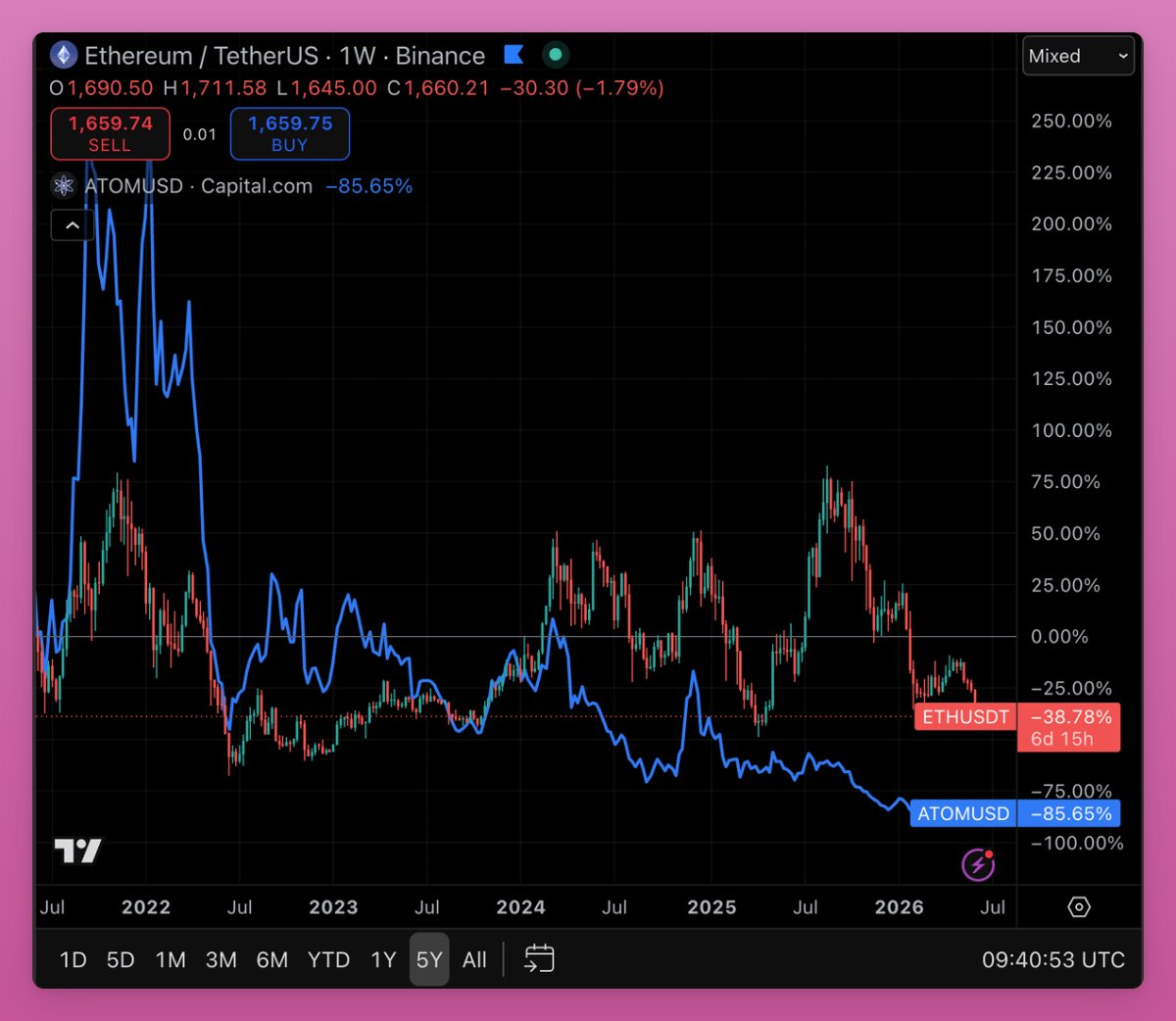
ATOM is down ~86% over five years. ETH 'only' 38%.
The big shift was valuing L1s mostly based on fees/revenue.
I think that's flawed for L1s but $HYPE and $TRX proved that L1s can actually generate high enough fees and burn tokens via buybacks to affect the price.
Cosmos community was asking FOR YEARS to fix ATOM's inflation and weak value accrual, and nothing changed until an 86% dump forced it.
Even a founder was pushing for a hard fork.
Apathy set in within Atom and no one even talks about it on CT anymore.
Now they're redesigning ATOM to capture value instead of just paying stakers to hold. Current proposals:
• inflation tied to actual fee revenue (currently a fixed 7-10%)
• longer staking locks earn more
• value accrual extended to SDK (corporate) usage, beyond staking yields alone
$ATOM holders are so desperate they are willing to experiment.
$ETH is at way too high MC and not desperate enough to make any radical changes to it.
Vitalik called supporting ETH the asset 'outside the scope of the EF'.
So any big change probably would come the way it did for ATOM: a crisis deep enough that doing nothing becomes more costly than acting.
ETH still secures billions so too large for anyone to treat this as an emergency.
ATOM had to fall most of the way to zero before it could reinvent itself.
If ETH is on the same path, the level that unlocks it is a long way below here.

Tom Lee 上周再次大手笔买入126,971 枚 ETH,价值超过 2.1亿美元。目前,Bitmine 总持仓已达到 5,543,872 枚 ETH,市值超 93.1 亿美元,平均买入成本约 3,460 美元(确实不低)。
Bitmine 的核心战略叫 “Alchemy of 5%”(5% 炼金计划),目标是积累约 5% 的 ETH 总供应量(当前 ETH 总供应量约 1.207 亿枚,5% 对应约 604 万枚)。
目前持仓 5,543,872 ETH 已占总供应量的 4.59%,距离目标仅剩约 49 万枚。按照它近期的稳定加仓节奏,大概率在 2026 年底前就能达成目标。
Bitmine 将 ETH 定位为公司核心长期储备资产,而非短期交易筹码。
他们持续积累的同时,通过自有 MAVAN(Made in America Validator Network)平台进行大规模 staking。
目前已 staking 约 471.87 万枚(占比 85%+)。若全部完成 staking,预计年化收益可达 2.7 亿美元左右。
从Tom Lee操作看,这是机构战略性长期持仓玩法。

In all seriousness, I doubt Saylor will ever buy ETH, but refusing to consider it looks more ideological than rational.
BTC’s market cap is currently more than 6x larger than ETH’s.
If Saylor rotated roughly one-sixth of MSTR’s BTC capital into ETH, he would move toward a market-cap-balanced treasury, reduce overall concentration risk, and give MSTR direct exposure to the internet of finance (stablecoins and tokenization), while also generating much-needed cash flow to help pay dividends and debt obligations.
@fundstrat and @saylor should be talking about this.

中本聪的哲学构想:从相对性、对称性到无界的自由
人类对自然的认知与社会制度的演进,本质上是关于“约定”、“边界”与“共识”的探索。中本聪的比特币系统(Bitcoin)及其点对点(P2P)思想,并非单纯的技术发明,而是一场融合了自然科学与人文学科的深刻哲学实践,其认知深度足以媲美爱因斯坦。
一、 认知的起点:相对性与几何群结构
人类感知自然的基础源于一套“约定的起源”:
我:相对的组合(主客体归属感的划分)。
时间:相对的变化(变化的度量长度)。
空间:相对的位置(移动的度量)。
这三者并非绝对存在,而是仅仅存在于物质(能量)的相对性关系中,涌现为一种抽象的几何群结构。如果没有物质的相对性存在,时空与“我”的几何结构也就不复存在。
相对性自伽利略和爱因斯坦开始,成为了人类认知自然的公理约定。“相对性”的本质,即为“点对点”(P2P)。 爱因斯坦语境下的“完全的相对性”,也就是中本聪语境下的“完全的点对点”,二者都指向同一个终极状态——无界。
二、 约定的演化:对称性与非对称性
在相对性这个初始约定之上,延展出了对称性与非对称性的动态演化(即对称性破缺)。
宇宙与系统的运行遵循一个核心规律:约定本身是非对称的,而约定里的演化物是对称的。
在区块链中:中本聪的“最长链”规则是一种非对称的约定;而在最长链规则下,算力进行的 nonce 碰撞则是对称的。
在佛教中:佛法僧三宝中,“佛”(本源/造物)是非对称的,“僧”(修行者群体)是对称的,而“法”则是连接佛与僧的代码与规则。
在哲学中:毛泽东通过人文学科的思考,很早就悟透了李政道在物理学上的“对称性”表达,理解了对称与非对称之间动态演化的奥秘。
三、 系统的悖论:完全性(无界)与一致性(统一)
如果“无界”代表着完全开放的点对点相容,“统一”代表着规则的一致性,那么人类的组织形态始终面临着哥德尔不完全定理的诅咒:一个系统无法同时确定其“完全性”(无界)与“一致性”(统一)。
基于这一底层逻辑,我们可以看透不同组织结构的宿命:
国家结构(追求一致性,舍弃完全性): 国家逻辑机械性过强,为了追求“确定的统一”,系统必须排除异己以维持一致性。这种群体一致性的统一过程,必然导致系统无法相容一切,最终表现为国家历史中“分久必合,合久必分”的周期律。
佛教体系(追求完全性,舍弃一致性): 佛教的直觉选择极强,追求“佛法无边”(无界),能够相容一切。正是因为舍弃了确定性的一致(最长链验证的规则不够一致),佛教才得以通过群体的完全相容性一直延续至今。
四、 重构社会契约:中本聪的设计哲学
爱因斯坦的相对论(自然科学)、马克思的无产阶级思想(人文学科)与中本聪的点对点网络,在底层思想上是高度一致的。中本聪的点对点,正是人文科学与自然科学的完美结合。
以美国三权分立的民主架构为例:
其最大的缺陷在于,它只给予了“选举最高权力”的平等与自由,却没有给予“行使权力”的自由和平等(其权力行使本质上是 PoS 权益证明形式)。
如果按照中本聪的思想改造美国制度,那么不仅要把“选择总统的权力”赋予点对点(P2P),更要把“总统行使的每一项权力”都下放到点对点。这意味着每个人不仅选总统,还要参与决定总统的具体决策。在这种架构下,“总统”将不再是具象的权力实体,而仅仅蜕变成一个“不确定的、抽象的最长链”。
五、 结语:无界的最长链共识
中本聪思想的终极目的,是实现无界的自由。
为了达到这种“完全性的自由与公平”,同时避免系统被逻辑越界造成机械化僵死,中本聪在“哥德尔不完全定理”的约束下做出了天才的选择:追求“确定的无界”,接受“不确定性的一致性统一”。
可度量这一目标的标准就是“点对点”。要达到完全的点对点,就需要构建“无界的最长链共识”——即在一个完全开放的前提下,以时间发生的客观事实为依据,从而收敛出的一种无界的统一。
在这个共识里,Bitcoin 的最长链如同浩瀚宇宙中的时空一样,成为了有限无界的群体之间,通过相对性关系涌现出的最伟大的抽象几何结构。

Imagine for a moment that you run a stablecoin business.
It’s a genius idea, really. People wire you $1, and you issue them a token. We’ll call it SUPERUSD.
People can always redeem their 1 USD, which is why 1 SUPERUSD remains pegged to 1 USD.
You are the first to offer this service at scale, so people pile in. Suddenly, there are billions of dollars’ worth of SUPERUSD onchain.
You start buying super-low-risk Treasury bonds in size, as you realize nobody will ever really redeem all USD at once. As long as there’s a large enough buffer available for redemptions, you can basically earn money on your cash reserve.
Similar to a bank.
Your business is thriving. Since your token is well integrated into DeFi, there’s little alternative. And with competition still thin, people don’t really care much about the yield you are extracting from their locked-up USD.
As your supply increases, you become one of the most capital-efficient companies in the world.
You make billions of dollars each year on your >$100B stack of cash.
However, the majority of your SUPERUSD is issued on a single blockchain:
Ethereum.
Also, there are competitors now. They start offering yield sharing to chains and businesses, eating into your potential market share and growth.
It looks like the days of making 5% on your stack of cash are numbered. More and more people are becoming yield-sensitive, and competitors are becoming more and more integrated as well.
It looks like making money on the yield is a race to zero.
So how will you protect yourself against this?
How do you ensure you keep your market-share dominance without losing out on all those sweet profits?
Simple: You start buying and staking ETH.
This way, not only will you earn fees from every single SUPERUSD transfer ever made on the network where the majority of all SUPERUSD lives, but you’ll also earn a share of all fees paid by your competitors.
Genius, really.
You also actively profit from the growth of the network as a first adopter.
JK.
You buy BTC… loads of BTC, because you are a toxic Bitcoin-maxi corp.
The end.

以太坊的终极形态,是怎么样的?
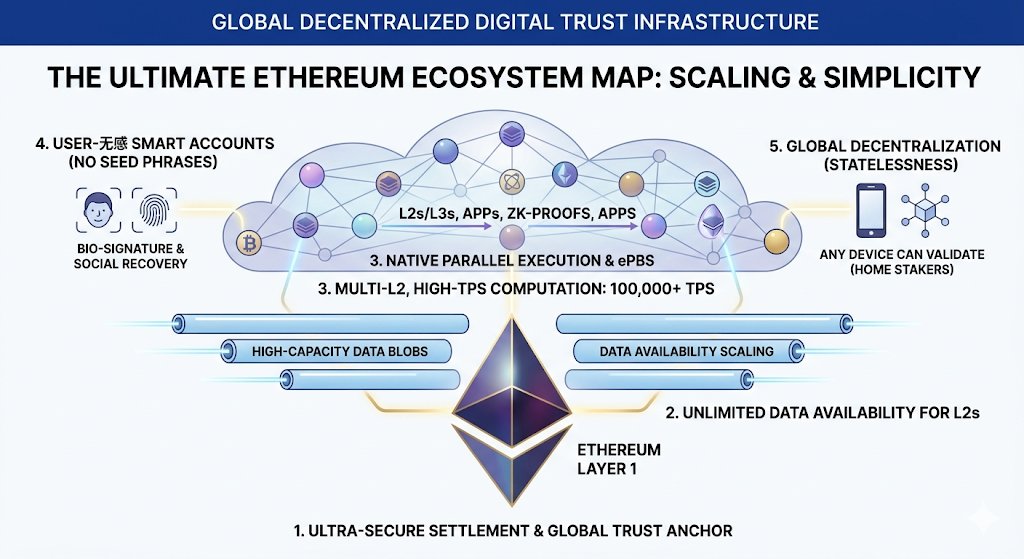
我们可以从以下四个维度,直观地勾勒出以太坊完成全部进化后的终极模样:
一、 底层架构:极度安全的“结算与数据可用性中心”
在终极形态下,以太坊 Layer 1 主网将不再拥挤,它不再直接处理普通用户的日常交易,而是退居幕后,专注于两件事:
极致的安全与结算(Security & Settlement): 依托于 PoS 机制和庞大的质押资产(Staking),主网成为全球最不可篡改、最具经济安全性的账本。所有的 Layer 2(如 Arbitrum, Optimism, Base, Scroll 等)都在其上进行最后的安全结算。
无限的数据管道(Data Availability): 通过 PeerDAS 和完全分片(Danksharding)的演进,主网的 Blob 管道变得极宽。主网只作为海量 L2 交易数据的“临时存储和验证中心”,将数据可用性供给提升到极致。
二、 运行门槛:真正的“无状态客户端”与全网去中心化
过去的公链往往随着时间推移,账本越来越大,导致只有昂贵的工业服务器才能运行节点。以太坊的终极形态彻底打破了这一魔咒:
沃克尔树(Verkle Trees) 彻底取代旧架构,数据证明体积暴减。
实现无状态(Statelessness):验证节点无需在本地硬盘存储几十个 TB 的完整历史账本。
终极结果: 运行一个以太坊全节点的硬件门槛极低,甚至一台普通的笔记本电脑或一部智能手机,都能在后台安全地参与全网共识验证。网络真正做到了“坚不可摧、无处不在”。
三、 用户体验:Web2 级的“无感智能账户”
对于普通用户而言,以太坊的底层密码学概念将完全隐藏在幕后:
助记词成为历史: 传统的 EOA 钱包(私钥钱包)被彻底淘汰,全网原生普及智能合约账户(Native Account Abstraction)。
生物识别签名: 依托于底层对 secp256r1 加密曲线的原生支持,用户可以直接用手机的 Face ID(面容)、Touch ID(指纹) 或 Passkey 来安全控制去中心化资产。
丝滑交互: 支持“批量交易”(点一次同时完成授权和兑换)、“Gas 费代付”(应用开发者帮用户出手续费,或者用户直接用稳定币支付 Gas 费)。普通人甚至不知道自己正在使用区块链。
四、 性能表现:10 万+ TPS 的全球计算矩阵
Layer 1(并行计算): 主网由于引入了并行交易处理和 ePBS 架构,其自身的 Gas 上限被推高到数亿级别,单层性能就能达到数万 TPS。
Layer 2(百花齐放): 无数的 L2、L3、应用链(AppChains)在上方纵横交错。由于底层数据空间无限大,L2 的交易手续费无限趋近于零(小于 $0.001),全生态吞吐量轻松突破 100,000+ TPS。
🌟 终极形态一句话总结:
“以太坊将成为像互联网 TCP/IP 协议一样隐形但不可或缺的底层基础设施——在上方(L2),它是承载全球数十亿人高频交互的超级数字社会;在下方(L1),它是用数学和密码学捍卫全人类资产与主权的终极信任机器。”

I find it funny that $ETH was supposed to benefit from the stablecoin boom:
- It's the settlement chain for stablecoins
- Where the TVL for yield bearing stablecoins live
- Where the infra for hosting stablecoins via DeFi is hosted
But of course, that's not where the value lies for $ETH the token. In fact, ETH was able to capture nothing from all of the above. It's one of the reasons it's traded so poorly, it's just not been able to monetise well of any of the above well enough. That's despite there being 160 billion in stables sitting on ETH mainnet.
Instead, there's another chain that makes $200-250m annualised in real revenue that accrues to 1 token because of stablecoins and not even anywhere near 160b, just a tiny fraction of that at 6b.
It's real USDC value and it comes from pure negotiating power to get the most for them and it's token.
Hyperliquid

Zcash 被发现一个存在四年可被无限增发的 Bug,代币直接暴跌 30%。这件事更可怕的是,这个 bug 是研究员使用 Opus 4.8 自动化审计、自主发现的。
作者有一套叫 zcash-full-stack-auditor 的 agent 框架。5 月 28 日(也就是 Opus 4.8 发布当天)他启动了对 halo2(Zcash 的零知识证明库)实现的自动化审计,范围涵盖 Orchard 电路。框架先跑一个"初始化阶段",把相关代码位置、规范条款、安全属性、失败模式全部枚举出来。
5 月 29 日下午约 2 点,初始化完成后他启动了"审计阶段"——框架给清单里每一项分配相应类型的审计 agent,这次跑的就是 Opus 4.8,调成了 max effort。
当天约下午 6 点,一个审计 agent 报出了 Orchard 电路里的一个严重漏洞,声称可以双花(double-spend)Orchard 笔记。作者当晚晚些时候才注意到这条发现,随后逐步验证、上报、做 PoC:
1. 他先让 Claude 针对一个类似"多样化地址完整性"(diversified address integrity)的简化电路写了第一个 PoC,确认漏洞大概率为真,当晚 11:53 通过 Signal 上报给 Daira Emma Hopwood 和 Kris Nuttycombe。
2. 再让 Claude 针对真实 Orchard 电路写第二个 PoC,演示了"对同一笔记揭示多个不同 nullifier"从而双花,周六凌晨 2:06 交付,并建议紧急停用 Orchard。
3. 最后开发了一个 RPC 测试,把一笔 Orchard 笔记的价值不断翻倍,直到 regtest 钱包余额超过 1000 万 ZEC,证明增发攻击确实可被利用(regtest 用的是和主网完全相同的规则和零知识证明验证,交易没有广播到测试网或主网)。
值得注意的是关于"可发现性"的部分:作者之前用同一套框架但跑的是 Opus 4.7 xhigh,并没有找到这个 bug;后来确认 4.7 只有在被非常具体地指引时才找得到。即便是 4.8,用比较泛化的提示时也只在 4 次测试里命中 1 次。一个可能的差异是这次他把 halo2 book 喂进了初始化阶段(以往只喂协议规范和 ZIP)。漏洞自 Orchard 上线起就存在了 4 年多,且上线前做过深入的人工审计都没发现——说明它对人类相当难找。
Opus 4.8 扮演了什么角色
它基本上是整条链路的核心,从发现到验证都深度参与:
自主发现:在 max effort 下运行的审计 agent 自己定位到了这个严重漏洞,这是整个事件的起点。
独立推导数学:漏洞在于电路对标量乘法的基点 base 没有施加约束,攻击者可以任意选取这个 base。给定目标的 pk_d、g_d、ivk,需要反推出 base 应该设成什么值才能让 [ivk]g_d 等于 pk_d。报告里明确写道这步代数完全是 Opus 4.8 自己算出来的,作者没给任何提示,并说自己没有 AI 的话会花很长时间。
写 PoC 和 RPC 测试:两个 PoC 和最终那个增发测试都是 Claude 写的。开发 RPC 测试约花了 6 小时,期间 Opus 4.8 几乎不太需要人工指导,作者只给了两点提示(如何处理 action bundle 被重排序、以及 prover 生成证明时的多次 pass)。
辅助分析与缓解:作者还让 Claude 对漏洞曝光窗口内的链上交易做了统计分析,查是否有被实际利用的迹象(结论不确定,因为屏蔽交易本身方差就高);长期缓解建议里也用 AI 跑了一遍"能否把某个 assign_advice 的值改成别的而不违反任何约束"的检查。
一个有意思的行为细节:报告说 Opus 4.8 对自己找到的是不是真漏洞极度怀疑——它倾向于认为上游代码经过审计所以应该是对的,或者觉得自己看的是被人故意植入后门的版本,需要作者"推一把"才肯认真对待这个发现。

这一波各大Cex集体上线美股交易,感觉给了二线所追赶Binance的机会。当然,反超目前看不到,只是说差距有可能被拉小
之前大家玩现货,像我几乎只用币安的原因,一部分是安全上的信任,体验的丝滑。另一部分就是币安上面主流山寨的数量+流动性深度是远超其他所的。你买卖一个币几万U,别的所市价可能5%一根针出去了,于是只能挂单接,币安上市价直接滑点1%之内就成交了
当年在ABCDE的时候跟做市商聊,做市商也表示同一个币,Binance可以退出的流动性比其他所多一个零
但到了加密美股时代,除了BTC,ETH这些共识资产,与Lab这种操盘妖币之外,同一个App里你看到山寨VC和旁边标签栏里的NVDA,MU这些,你还怎么下得去手买山寨? 绝大多数的的山寨流动性都会慢慢被虹吸到美股那边
然后你发现Binance,Bitget,Gate等加密美股CEX后面,都站着Alpaca这同一家券商。换句话说,以前山寨币数量,流动性和滑点的优势,现在几家被彻底抹平了
目前拼的只能是UI,用户体验,交易费用这些,后续可能还会有KYC,合规,税务等后续的因素影响
BTW,昨天跟一家量化聊,貌似几家也都还没开放美股这边的API,所以量化团队们都还没接进去,等到开放API之后,相信又会是CEX美股大战的下一阶段
最后再替Alpaca捏一把汗,讲真这也算是个不大不小的单点风险,服务了这么多圈内交易所,相当于变相服务了不少币圈用户。从税务和法律的角度,SEC会不会把视线投过来?虽说Alpaca是持牌券商,受FINRA/SEC监管,本身就在SEC视野里,但CEX的用户KYC标准和传统券商毕竟不同,Alpaca作为底层通道,是否要对终端用户的合规性负责?可能会是未来一个潜在的法律敞口或是争议的地方
Anyway,有竞争是好事,我个人依旧是币安粉,也希望其他所加油,这一轮能够赶上来!

I don’t think ppl fully comprehend the network effects that Ethereum has in the developer community.
There is so much more tooling for EVM development, and solidity in particular, than any other crypto developer platform in the world. It’s not even close.
When it comes to building in this industry, Ethereum *is* crypto, blockchain, onchain, and anything else you want to call it.
The idea that this won’t one day translate into immense value for the native asset is ridiculous.
Eventually there will be so many things that you can do with ETH that it’ll have infinite use cases.
All of that will lead to unprecedented digital provenance.
This isn’t memetic. This is stone cold brand recognition. It’s moat building.
The ticker is ETH frens.
That’s it that’s all.
Stripe、Visa、Mastercard(可能加上Coinbase)正计划组建财团,推出新稳定币或稳定币平台,目标直指Circle(USDC)和Tether(USDT)。
Visa/Mastercard的全球商户网络 + Stripe的支付基础设施 + Coinbase的crypto入口,有机会带来TradFi资金、支付流量、真实世界资产上链。
稳定币未来突破万亿大概率是迟早的事情。由于流动性的原因,以太坊也会受益(不同主体发行稳定币对于中性平台反而有利)。

想继续吃Crypto这碗饭,你一定要懂得的道理:
1)回看过往几轮周期,加密行业几乎每轮都要濒死一次才能重生,暴跌90%、80%、70%后再V转起飞是常态,高波动性是行业的基本盘没错,但别忘了,极强的生命韧性也是,死不掉的;
2)CEX交易所从来都不是加密行业的救世主,某种程度上他们甚至都不属于加密行业。做交易平台“抽水”是永恒的,至于平台上交易的是主流加密货币,MEME币,还是美股期货、原油、贵金属都不重要;
3)链上叙事创新本轮确实存在大量的VC项目“骗局”,但最终能把加密行业带出颓靡的仍会是一次次磅礴的大叙事。就像20年的DeFi、22年的NFT、23年的铭文、24年的Agent等一样,叙事的持续性和高度决定了牛市的厚度以及泡沫后灾后重建的难度,但没有“创新叙事”的加密行业真的不行;
4)推特CT上汹涌着大量或Fomo上头、或尖锐锋芒、或对立冲突的声音,到底来都是二级行情不好显性化的表现,看一看,消遣消遣就好了。若真到了加密行业跨踏式衰亡的那一天,没有一个人能够独善其身,还是那句话,各位伟大的“美股交易员”,请务必敬畏下自己的来时路;
5)既得利益者或早期得利OG,他们有的人修仙隐退了,有的人退居幕后作恶,有的人还在死磕坚守布道,这并不可怕,更可怕的是大部分人都选择了“沉默”。沉默的代价绝对会是“劣币驱逐良币”的持续发酵,这对行业带来的“共识”摧残才是最致命的。

Re-posting the idea from the second half of this post a few months ago https://t.co/5yHyRCsvVV:
(This is very relevant to the options ideas from yesterday)
Question: if we're making a synthetic stable, what should it really be stable WITH RESPECT TO? USD is actually far from the best choice.
---
What do people who want stablecoins ultimately want? They want price stability. They have some future expenses in mind, and they want a guarantee that will be able to pay those expenses. But if crypto grows on top of USD-backed stablecoins, crypto is ultimately not truly decentralized. Furthermore, different people have different types of expenses. There has been lots of thinking about making an "ideal stablecoin" that is based on some decentralized global price index, but what if the real solution is to go a step further, and get rid of the concept of currency altogether?
Here's the idea. You have price indices on all major categories of goods and services that people buy (treating physical goods/services in different regions as different categories), and prediction markets on each category. Each user (individual or business) has a local LLM that understands that user's expenses, and offers the user a personalized basket of prediction market shares, representing "N days of that user's expected future expenses".
Now, we do not need fiat currency at all! People can hold stocks, ETH, or whatever else to grow wealth, and personalized prediction market shares when they want stability.

Wow, what a moment to see that Alphabet is hitting the primary market to raise a whopping 80Bn dollars (consider GOOG raised less than 2Bn at IPO 20+years ago)! While the main focus has been on the unusual scale of the ATM offering alongside Berkshire Hathaway's "signal", I actually think the most interesting feature is what crypto investors already have some unique insights to underwrite: the 15Bn dollars to be raised in the form of a MANDATORY CONVERTIBLE PREFERRED offering-
As I've written about before, the preferred equities market is the "armpit of American securities"; it is has neither the protective features of debt nor the upside potential of equity growth and therefore is generally used sparingly by third tier companies that have some features of adverse selection at play. It's used most commonly by banks for example when they need regulatory relief capital, or by industrials like airlines when they have specific capex needs that are too cyclical for even the most credit oriented, and very rarely ever used by pristine tech companies. In fact, the only time that I can even recall that it was used by the tech sector was in 2008 after the GFC to recapitalize (coincidentally, many will remember the outsized role that Berkshire Hathaway played by trading the security of its name to arbitrage pricing for the favor of rescuing certain banks-- more on that later)
I've also written before that if there is one thing that the crypto industry is very good at, it is inventing novel form factors of instrument specifications regardless of whether the underlying asset exposure is actually crypto native or not: perps, stablecoins, binaries that found product market fit, not necessarily only in tokens, but broadly for the securities market. It is now time to add preferred equities into that mix, for I see a lot of parallels here for what GOOG is doing versus what MSTR has been pursuing for several years now-
The GOOG pref is not particularly cheap. It is approx. 150bps over (and ~100bps richer than its own debt) as a AA+ issuer they could get away with, and also caps some upside participation with basically full downside participation. For many specialists, it is not a very interesting instrument with a clear mandate. However, it signals two bets that GOOG is making: 1) there is going to be a large unfulfilled customer base that want higher yield that is willing to give up the volatility of the underlying growth if there is the perception of asset backed collateral/spend, and 2) Google wants to have access to this temporal dislocation because they are unable to make a termed bet on how the AI bets are going to pay off just yet. It's not unlike how Strategy approached the same market betting on both of those views, just replace AI with Bitcoin with an uncertain timeline for a certain outcome.
On a more long term view, it's an early sign (or warning?) of reimagining what the corporate issuance market will look like when investors ultimately decide that certain "national security strategic companies" are more creditworthy than government spreads themselves in a post-Davos world, where investors are willing to tolerate a give up on the supposed risk free rate that does not allow you to outperform inflation and that the source of inflation may actually be more directly correlated to companies like GOOG that can price that cost of capital more cleanly as the true risk free rate. That is why I think seeing Berkshire Hathaway in this mix is particularly hard hitting; just as it saved the American economy via bailing out the banks in 2008, there is an uncomfortable sense that this, too, feels like a version of preemptive public-priviate financing for a bet the country cannot afford to risk losing. For while financial engineering without leverage is an optimization game, once you introduce leverage (esp unsecured), it becomes a confidence game. What this means is we may likely see a lot of preferred issuances that are now normalized as regular course of business in the future (just as bank bailouts did).
This also means there's going to be a fair amount of relative value alpha in this new cohort of securities trading endeavors in a special sits format that new investors won't necessarily know how to navigate. People might not first think that this phenomenon is "crypto alpha" but in fact, it is my own conviction that it is absolutely birthed out of crypto alpha lores. Crypto has always been about capturing the ambiguous risk preference within an asset liability matching framework that investors have long misunderstood their time horizon relative to their own capital formation behavior. Take for example, STRC dropping to <97 this week for what otherwise investors are struggling to decipher the true cost of liquidity.
The opportunity for crypto alpha has never been higher, never been more durable, never been more scalable. In fact, I think its entirely possible that we may see perpetual prefs by some of the best tech companies arrive in the future. It will no longer just be a play thing for DATs, but rather reconfigure the social contract of what "digital credit" might be. It will shock some traditional and institutional investors that have never seen it, but for those of us here who've been following the crypto journey will realize that it was only a matter of time: for crypto's greatest product market fit is the hyperfinancialization of the time preference arbitrage at the intersection of yield and volatility.
I'm excited to have GOOG join us.

Vitalik提出的一个很新奇的思路,用期权为基础构建合成资产代替传统的CDP+Oracle+liquidations的模式。 用在稳定币上很优雅,把ETH拆成了一个稳定币和一个杠杆代币。
P+N=1的数学实现让我联想到了提出AMM的xy=k时刻。
研究如下:
先解释一下这里合成资产指的是,比如你要在链上构建一个稳定币, 去中心化的方式你需要一个Oracle价格,和ETH CDP抵押清算系统,这就是最早MakerDAO的形式。
如果从纯粹性上来说,这套系统还需要依赖一个外部信任就是Oracle,同时需要设计好清算系统,要有足够的风控措施和缓冲机制,否则会出现类似312的情况。
Vitalik的方案看起来更加优雅,用期权为基础取代债务系统,首先就是不会有清算这个风险了,具体来说就是把1 ETH分割成一对互补的合成期权:
P:看跌期权(保护下跌)
N:看涨期权(捕捉上涨)
任何时候都可以用1 ETH拆分成(P, N),或把(P, N)合并回1 ETH。
数学实现就是 P+N=1。
(这种比较纯粹的实现类似于AMM的xy=k)
那么期权是有到期时间和行权价的,所以Oracle只需要在到期时进行一次报价,不需要实时报价,大大降低了Oracle风险。
如果对期权不太了解,可以简单认为把ETH拆成了两部分,P是跌了就保护你的保险,N是涨了就赚更多的彩票。不管底层的ETH如何波动,两者加起来永远等于1 ,永远不会多也不会少。
举个具体例子,
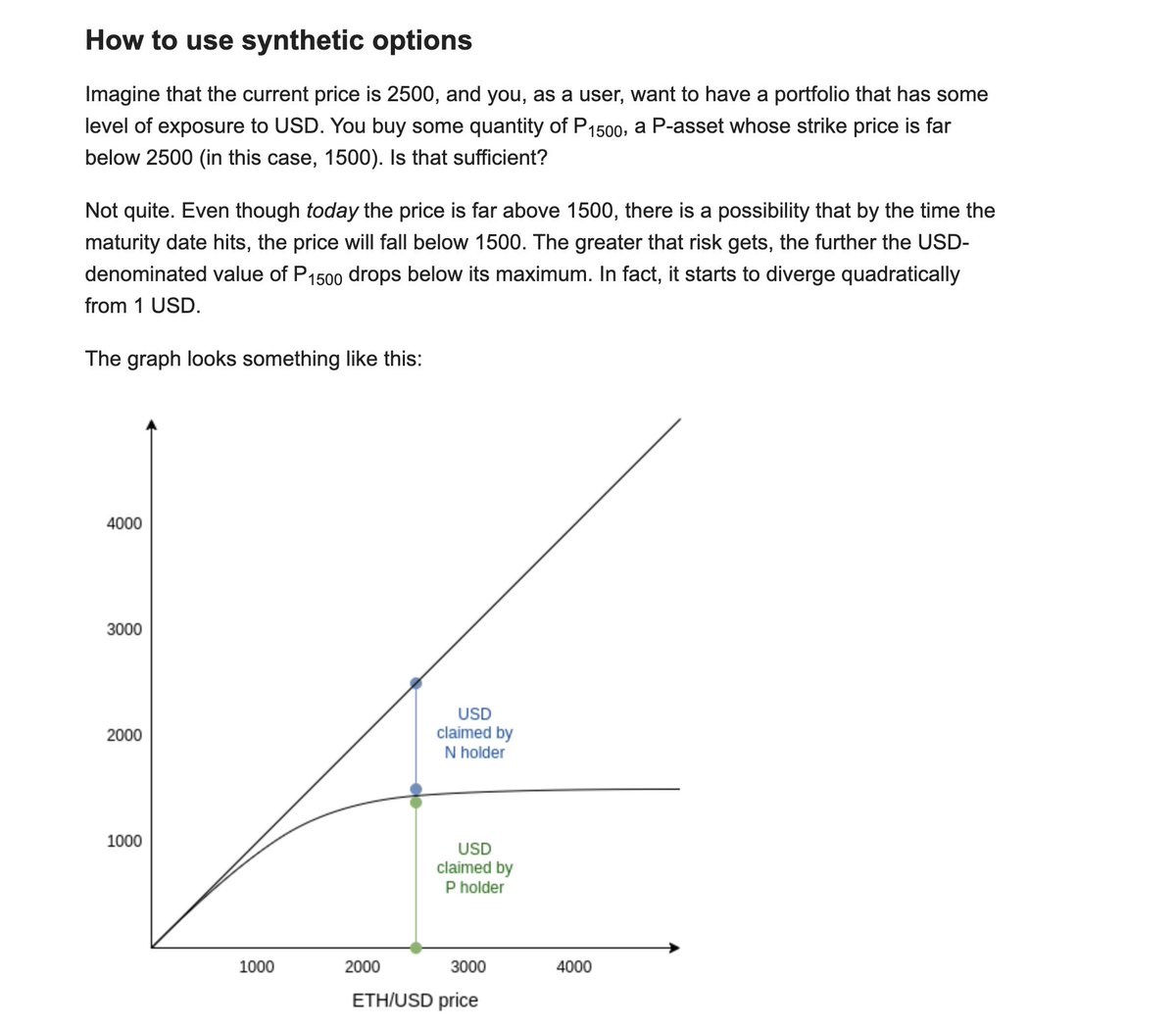
比如当前ETH=$2500,行权价选择s=$1500。P holder和N holder的关系可以看配图中的曲线。此时你持有1 ETH并拆分成P和N。
假设到期时价格来到x=$1800,会发生什么?
P=min(1,s/x) 取1 ETH和1500/1800 = 0.833 ETH的最小值,也就是0.833 ETH,这0.833 ETH当时的美元价值=1800×0.833≈正好1500美元。
N=max(0,1-s/x) 取0 ETH和1-0.833 = 0.167 ETH的最大值,也就是0.167 ETH,美元价值300美元。
两者的和刚好是1800美元,所以P+N=1永远平衡。
所以对于稳定币使用者来说,1 ETH拆分成P和N后,直接卖出N换成P即可。
但其实这里有一个关键问题,就是一旦跌破行权价s,那么P虽然还能拿到完整的1 ETH,但在美元本位上会亏损,那么用户就必须定期的去调整s,用旧P去换新P,让行权价s尽可能安全。这个过程的磨损和滑点都不太可控,用户自己去操作还有可能被MEV。
最后是V神表达了他对目前DeFi处境的观点,他认为DeFi不应该只是传统TradFi的复制品(比如CDP模式其实算是把传统金融的逻辑搬到链上),而应该在架构上彻底不同,即便牺牲一点便利性,换取更高的安全性和去中心化程度,也是更值得的。
可能有点难懂,但我尽可能融入我自己的理解来解释了,我觉得是一个很好的思路,优势是摆脱了对实时Oracle的依赖,即使出问题也有大量的时间可以介入,另外也能够给ETH更多的应用价值。当然具体的可行性还需要跑跑数据和模型来验证。
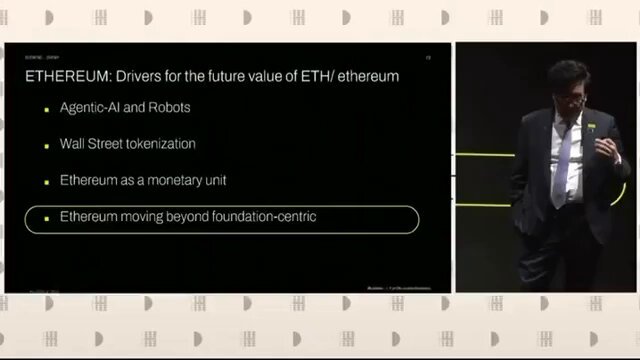
从视频看,Tom Lee回应了vitalik之前关于以太坊基金会专注于核心CROPS的帖子,他表示:
“以太坊DAT财库公司,包括 Bitmine 和 Sharplink 在内的财库——现在拥有 7% 的以太坊供应量……财库股票本质上是永久从生态系统中移除的供应量,但我们也拥有收益。收益大约为 3%,因此如今这些公共财库正在产生约 5 亿美元的奖励,这就是我们可以用来资助和资助加密生态系统的东西。”
简单来说,以太坊生态以后不用只靠基金会发钱了,现在这些DAT财库公司,可以拿出钱来支持项目、开发者、基础设施。
主要几点:
1. DAT财库公司已经囤了很多 ETH
像 Bitmine(Tom Lee )和 SharpLink 等上市公司,现在合计持有全网约 7% 的以太坊。这些公司把 ETH 当成“公司财库”长期持有。
2. 他们靠 staking 每年赚不少。把 ETH 质押到以太坊网络上帮忙维护安全,每年能赚约 3% 的收益。目前这些公司加起来,一年能拿到 约 5 亿美元 的以太坊奖励。
3. Tom Lee 认为,这些钱不要全留着,可以拿出一部分来资助以太坊生态(发 grant、支持项目、开发者、L2 等)。
以前主要靠 以太坊基金会(EF) 出钱,现在这些“DAT财库”也可以自己出钱了。
4. Tom Lee 认为以太坊基金会把重点缩小到最核心的事(CROPS:抗审查、开放、隐私、安全)是正确的决定。
因为以太坊现在已经很大了:
• 市值约 2400 亿美元
• 运行 11 年零宕机
• 全球 89 个国家、11500 个节点
• 15000 个开发者
一个基金会管不过来,未来更多事情要靠私营公司去做。
因为这代表以太坊生态的资金模式在进化:从“靠基金会财库”转向“靠市场化的大持有者自己赚钱反哺”。
这才是实现正向循环该做的事情。

作为交易所CEO,我大概每周都会被问到一次:“量子计算是不是马上要破解比特币了?加密行业是不是快走到头了?”
这个问题确实很宏大。刚好周末有点时间,我看了我司的某新加坡Top2学校密码学博士的内部分享,结合 Gemini Deep Research 跑出来的研究,彻头彻尾地盘了一遍。
剥开科幻电影般的焦虑外衣,我把大家的结论提炼成以下几个最核心的维度,跟大伙儿简单汇报一下:
1/ 理论上是“降维打击”,现实中是“不可能的温室”
量子比特的叠加态特性,确实能把破解非对称加密(比如大家熟悉的公钥私钥体系就是用ECC 椭圆曲线加密-一种非对称加密法)的时间从几百年缩短到几分钟。
但现实情况是: 现在的量子计算机基本只能活在极其苛刻的实验室条件下,堪称“不可能的温室”(比如要求是比宇宙深渊还要冷的“绝对零度”),失误率极高,投入产出比差得离谱。距离真正能商用、甚至拿来当黑客工具,中间还差着无数个物理学突破。至少在未来 5 到 10 年内,现有的加密体系是非常安全的。
2/ 真正面临威胁的,是那些“上古沉睡巨鲸”
为什么区块链行业对量子计算格外敏感?因为我们的账本是公开且不可篡改的。
平时大家转账,用到的是数字签名哈希。但像比特币早期的很多地址,公钥早就直接暴露在链上了。一旦量子计算成熟,这些暴露了公钥的“上古沉睡巨鲸地址”就有被直接反推私钥的风险。这种巨量远古资产(比如中本聪的币)如果被盗,确实会对市场生态造成巨大冲击。
3/ 交易所的对策:不要恐慌,也不要瞎折腾
密码学大神 Dan Boneh 有句话总结得特别好:“不恐慌,不匆忙,但也不忽视。”("Don't panic, don't rush, but don't ignore.")
有很多用户问,既然有隐患,交易所为什么不赶紧全面升级到“抗量子算法”?因为在实际的安全业务中,放弃当下极其可靠、经过时间检验的硬件加密设备,去强行上马一套还没完全成熟的后量子加密方案,这种“强行迁移”带来的系统性 Bug 和安全漏洞风险,要远远大于量子计算机本身的威胁。
总结
天还塌不下来。作为平台,我们的策略是密切盯紧学术界和可靠硬件厂商的后量子加密方案,当时机成熟时稳妥过渡。
至于大家,安心拿好手里的比特币、优质RWA代币,过好周末,别被远在天边的科幻焦虑给割了韭菜。😌
晚安,周一见~

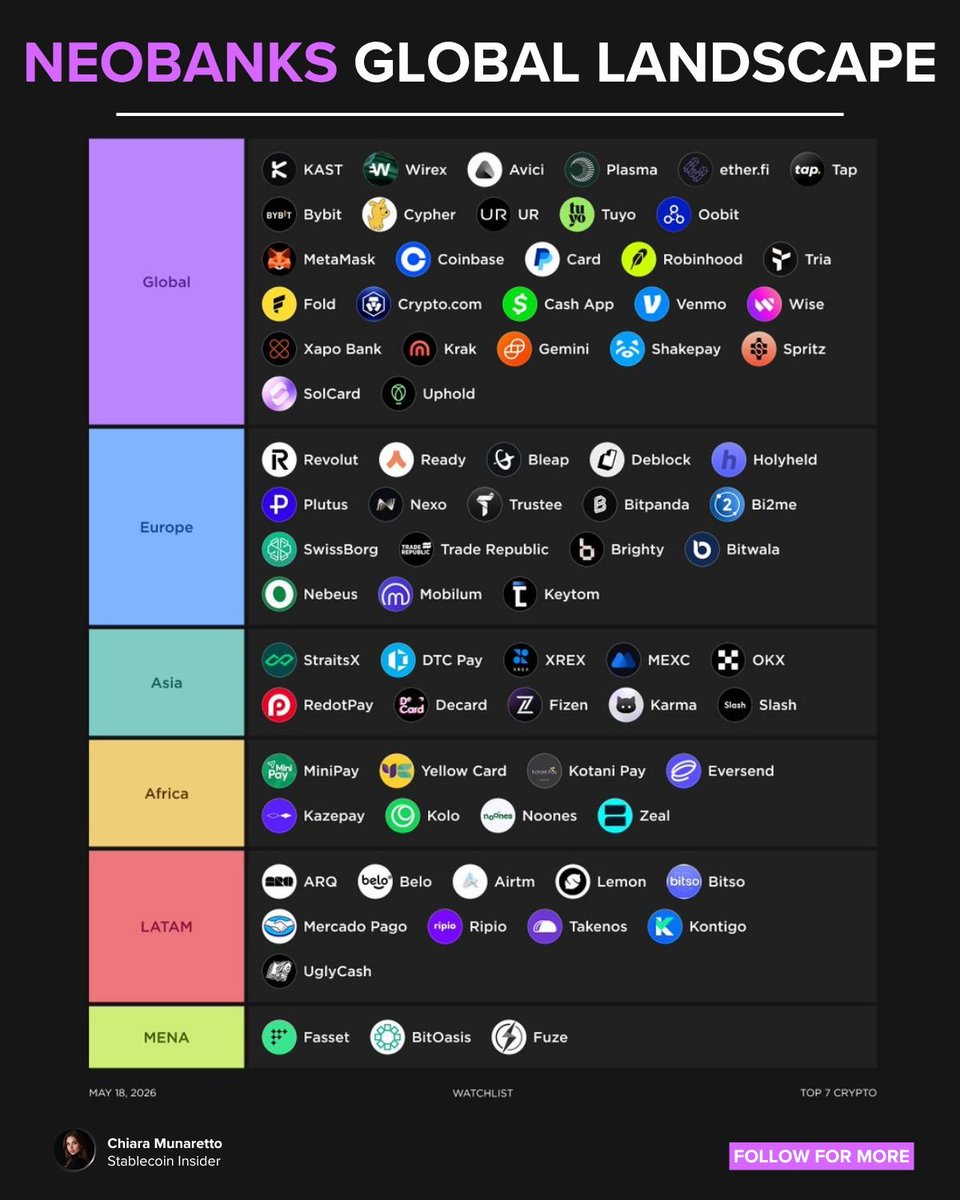
neobanks are being squeezed from two directions.
from the top, fintechs are pursuing bank charters to capture the economics they used to rent from sponsor banks: deposits, net interest income, payment access, and regulatory legitimacy.
from the bottom, stablecoins and public blockchains are rebuilding parts of the financial stack as open, programmable rails.
the result is compression.
the fat app thesis worked here, with the old neobank model being mostly a distribution layer:
- app + brand + customer relationship
- no balance sheet
- no direct rail access
- no deposit economics
the winning playbook is to own the economics. banking value does not accrue primarily to ux. it accrues to monetizable control points across store > move > grow > borrow money, such as:
- deposits
- credit
- settlement
- compliance
- liquidity
- customer trust
a neobank without these is just a frontend with rented economics.
this is why charters matter. a charter turns a neobank from a customer-acquisition machine into a balance-sheet business.
but charters are only half the story.
stablecoins attack the same stack from below by making settlement global, programmable, and cheaper. they weaken the monopoly of gated rails like ach, swift, and correspondent banking.
so the winning model is hybrid financial infrastructure: a mix of tradfi + crypto.
- regulated balance sheet where trust is required
- blockchain rails where speed and programmability matter
- defi protocols where financial products can be composed
- consumer apps where the relationship is owned
the future neobank is therefore not just a bank app.
most fintechs monetize only one layer. the trillion-dollar neobank captures all four.
this creates clear winners and losers.
winners:
- chartered fintechs
- crypto exchanges with distribution
- wallets that become financial apps
- defi protocols with real integrations
- stablecoin rails embedded into consumer finance
losers:
- middleware-dependent neobanks
- remittance firms relying on fx spreads
- wallets with no monetization
- banks with legacy ux
- defi protocols with no distribution
financial infrastructure is becoming more modular at the backend, but more consolidated at the frontend.
users will not care whether yield comes from a bank deposit, tokenized t-bills, @aave, @Morpho, or a stablecoin vault.
they will care about one thing if the app can be trusted to help them store, move, earn, borrow, and spend money better than their bank.
that is the endgame.
the bank account becomes a wallet.
the wallet becomes a bank.
the winner owns the interface between regulated finance and permissionless rails.
everything else is rented infrastructure.
日历
6 月 10 日
暂无重要事件